Full article about Ucanha’s River & Toll-Tower Bridge Whisper Time
Stone lanes, 349 souls, medieval toll bridge cooled by Varosa’s rush
Hide article Read full article
Ucanha, where the river keeps the beat
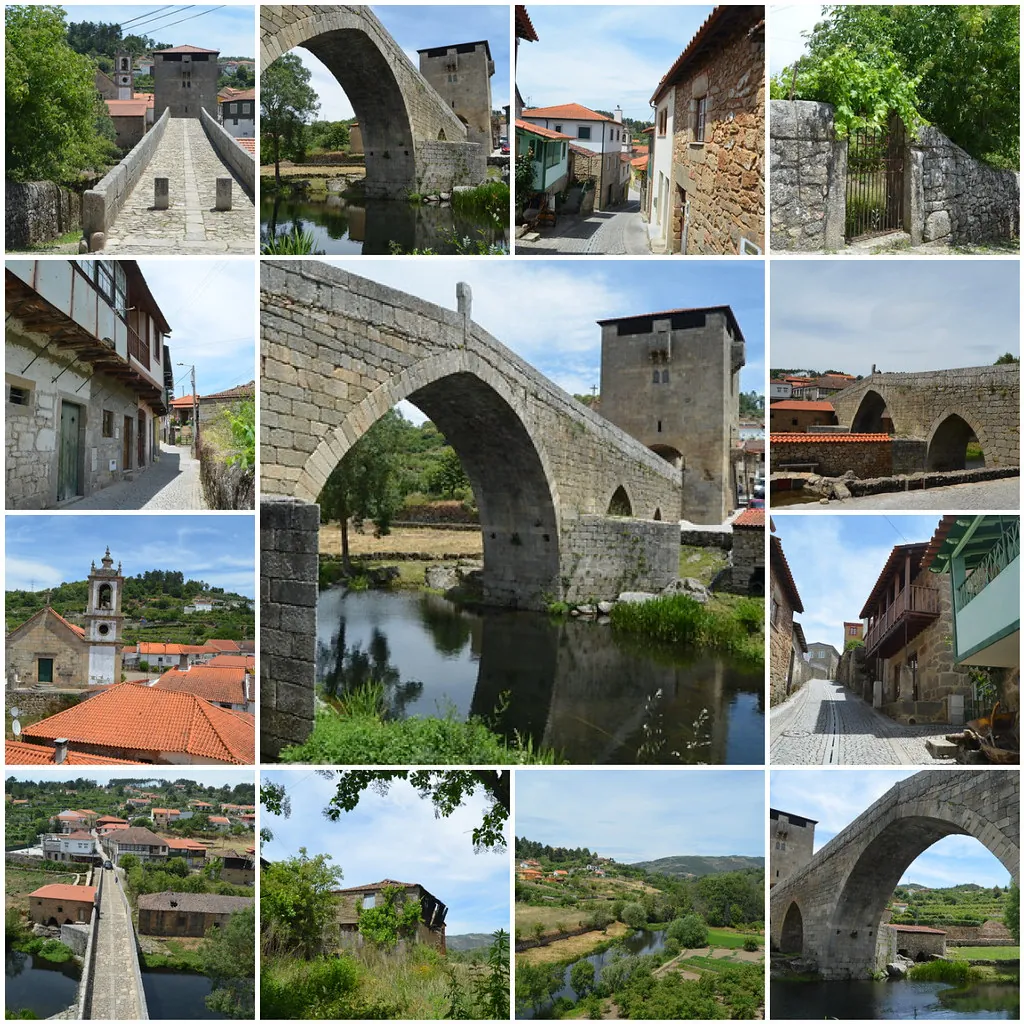
The sound arrives before the sight: a filament of water combing over granite, steady enough to be mistaken for silence. The lane corkscrews down between moss-padded walls until the valley unclenches and the fortified tower shows itself—rectangular, unadorned, the colour of weathered gunmetal. You brake without thinking, not for a photo but because your pulse has already down-shifted. Something in the body recognises tempo here: 40 bpm, the cadence of stone and slow water.
349 reasons to hear yourself breathe
The 2021 census gives Ucanha 349 inhabitants. That is not a headline; it is a texture. It means the schist lanes are empty at 11 a.m., that a closing door throws an echo down the hill, that a distant dog becomes the day’s news. One hundred and nineteen residents are over 65; only 27 are under 15. The demographic seesaw has stuck in mid-air, and every ordinary gesture—piling eucalyptus logs, drawing water from the public fountain—carries the ballast of centuries.
Altitude 572 m, territory 539 ha. Even in June the dawn air is sharp; the Varosa’s humidity climbs the ravine and coils around terraced vineyards that are not scenery but livelihood. Ucanha is one of only 11 villages officially classified as an Aldeia Vinhateira—wine village—within the Port demarcation. The vines are trained high enough to let a small tractor pass beneath, but September’s harvest is still done by hand, secateurs clipped to orange twine around the picker’s waist.
A bridge that once charged admission
Portugal counts only a handful of medieval toll-tower bridges still standing; Ucanha’s is the most intact. The granite blocks are the same temperature as the water below, cold even when the afternoon sun warms the adjacent cottages. Walking the worn slabs you automatically watch your feet; the centre is slightly dished from six centuries of hooves, iron tyres and, lately, weekend cyclists. Pause halfway and you hear what the Templars heard in the 12th century: the Varosa translating itself through the single arch, vowels of green Portuguese.
Beef, chestnuts and the gravity of autumn
Order the roast kid at O Mário and you are tasting a perimeter of about 15 km. The meat is Arouquesa DOP, mountain-reared oxen whose diet of broom and wild clover gives the fibre a mineral bite. In October the same slopes release Soutos da Lapa chestnuts, their protected origin echoing that of Parma ham or Jersey Royal potatoes. There is no tasting menu, no amuse-bouche—just a plate, a bottle of tannic local red, and the cook who learned the recipe from someone who learned it from someone born in the house you slept in.
Calendar days the village still honours
For 50 weeks Ucanha practices social distancing by geography. Then comes the double weekend of São Pedro (late June) followed by the Romaria de Santa Helena da Cruz (early July). Emigrants fly in from France and Switzerland, grand-children who answer to Buckinghamshire accents run through the churchyard, and the bell in the 18th-century tower strikes with a clarity you only get when no traffic competes. Book one of the four converted granite houses outside these dates and you will have 6.8 sq km of parish largely to yourself—lower population density than the Shetlands, minus the wind chill.
What the granite remembers
At dusk the west light strikes the toll tower and the stone turns from graphite to brief gold. Stand on the parapet, jacket zipped against the valley draught, and the last audible thing is not the river—that has become the auditory wallpaper—but the dry pop of an old vine cane contracting on the slope somewhere above you. Invisible, insistent, the way almost everything important in Ucanha insists on being felt rather than pointed out.