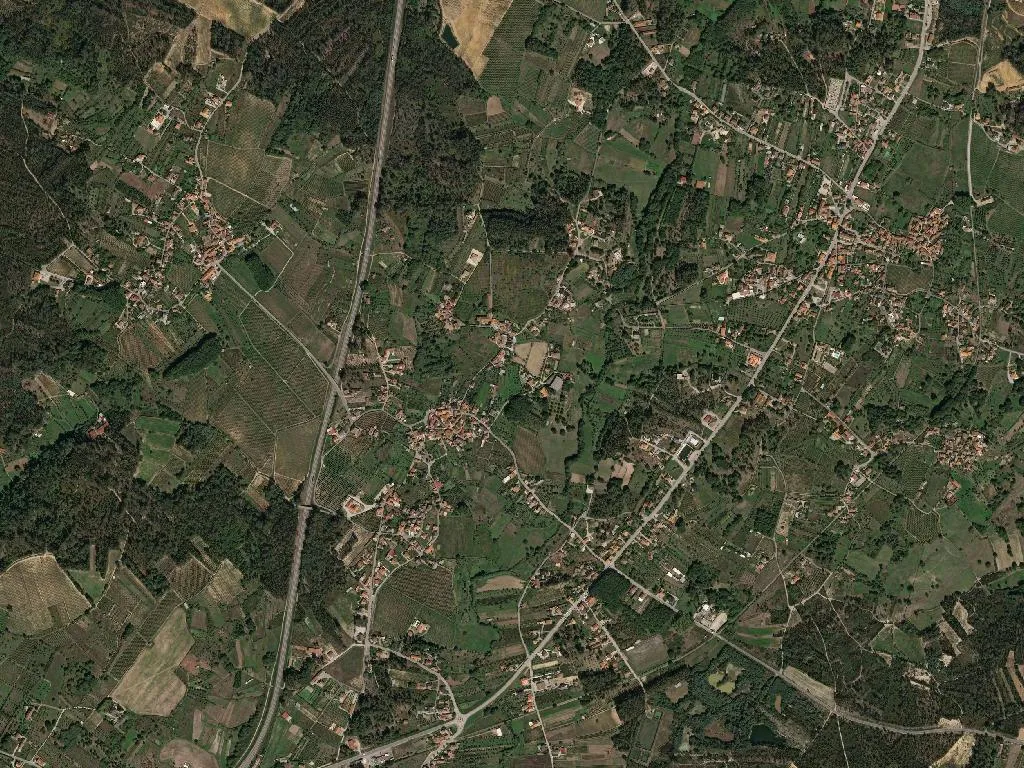
Full article about Canas de Santa Maria: Bell Echoes Over Dão Valley Vines
Time is kept by a bell, a sacristan’s watch and 1912 vines in this silent Tondela parish.
Hide article Read full article
The bell, the vines and the ledger
At five past eleven the church bell stops ringing, yet the note lingers, rolling down the schist-walled terraces that Abbot António Alves planted with vines in 1912. Behind the modest façade of the Igreja Matriz, the sacristan pockets his watch; there is still no clock in the tower, so the hour is his alone to keep. The sound settles over the 87 ha of vineyard that survive from the 112 ha recorded in 1958, then drifts towards the hulking granite corn-crib built by carpenter José da Conceição in 1937. Inside, hybrid maize supplied since 1987 by the local co-operative dries on slatted chestnut boards. The parish’s only tabby cat sleeps on the step; the Gomes family refuse to evict him even though their house, the last in the conservation zone without mains plumbing, is otherwise unoccupied.
Canas de Santa Maria, 1,607 souls scattered across the southern flank of the Dão valley, never learned to speak loudly. Its story is filed in the ledgers that parish priest José Martins Guarda compiled between 1865 and 1892, and in the 1253 charter of King Afonso III granting the monks of Viseu cathedral chapter the right to collect tithes here. When the 1758 ‘Parish Memories’ survey reached these slopes, officials listed “Casas de Canas” – 46 hearths, 180 inhabitants – and moved on. The charter is parchment; the survey is ink; the Romanesque nave of the mother church, raised late-13th century, is stone. A Gothic apse was stitched on after 1535, and in 1723 the Brotherhood of the Blessed Sacrament paid master carver José de Almeida 800,000 réis for a gilt baroque retable; the receipt, in sepia ink, is still in the parish safe.
Three monuments, no fair
The parish council, not the state, is custodian of every listed building: the mother church (National Monument since 1922), the single-nave Chapel of St Sebastian and the domed Chapel of the Conception (both classed “Property of Public Interest” in 1978). There are no fairs, no fireworks, no brass bands. The August 15 and January 20 processions follow the same 1801 route – church square, Rua da Igreja, Largo do Cruzeiro, back to church – and conclude with a collection plate and a polite nod. Tondela’s philharmonic played once, in 1974; when the musicians asked where the stage should go, the mayor replied, “There isn’t one.” The tradition endured: low mass, short walk, coins, home.
A micro-foodshed
Forty-two of Canas’ residents are registered producers: eighteen rear Serra da Estrela lamb, nine tend Arouquesa cows, fifteen make DOP sheep’s-cheese. Irene’s minuscule dairy (no. 14 Rua da Igreja) opens at 16:00 sharp, once the 13:00 milking has curdled; telephone first (232 941 233), then knock. Mr Albano’s milk-fed lambs are born in the slate sheds of Lagariça farm and reappear the following Tuesday in Dona Lurdes’ wood-fired oven. Reserve through the parish council weekdays 10:00-12:00. All wine is Dão: Quinta do Cão, Quinta da Taberna and Quinta do Mondego bottle within the parish limits. The communal cellar keeps Saturday hours 15:00-18:00, or whenever Sr Jacinto is not playing sueca cards.
Schist, vines and the river below
The Dão itself slips past three kilometres north, beyond a belt of pines and the Besteiros stream. Reach it by the municipal road, then a gravel turn-off at trig point 315-C. For altitude, take the EN230 twelve kilometres to Alto da Portela (540 m) and pick up the PR1-TON trail that links Tondela to the Cabreia waterfall. Inside the parish, the 2.4 km “Caminho do Xisto” footpath threads from the church to the Chapel of the Conception, passing the 1937 corn-crib and the 1942 wayside cross erected by the Guedes family after their son fell at Flanders. Cyclists can follow the old Vouga railway alignment – passenger service ended in 1988 – while drivers squeeze along the M514, barely wide enough for a tractor and a half. At kilometre three, a granite cross is carved “ORAÇÃO PELOS VIVOS 1946”; the spring beside it is no longer potable, yet Sr Jacinto keeps a tin cup nailed to the wall because “the cyclists ask.”
When the bell sounds again it is noon. The bakery shutters at 13:00, the tavern unlocks at 14:00, and Dona Lurdes’ corn bread is always gone by 12:30.