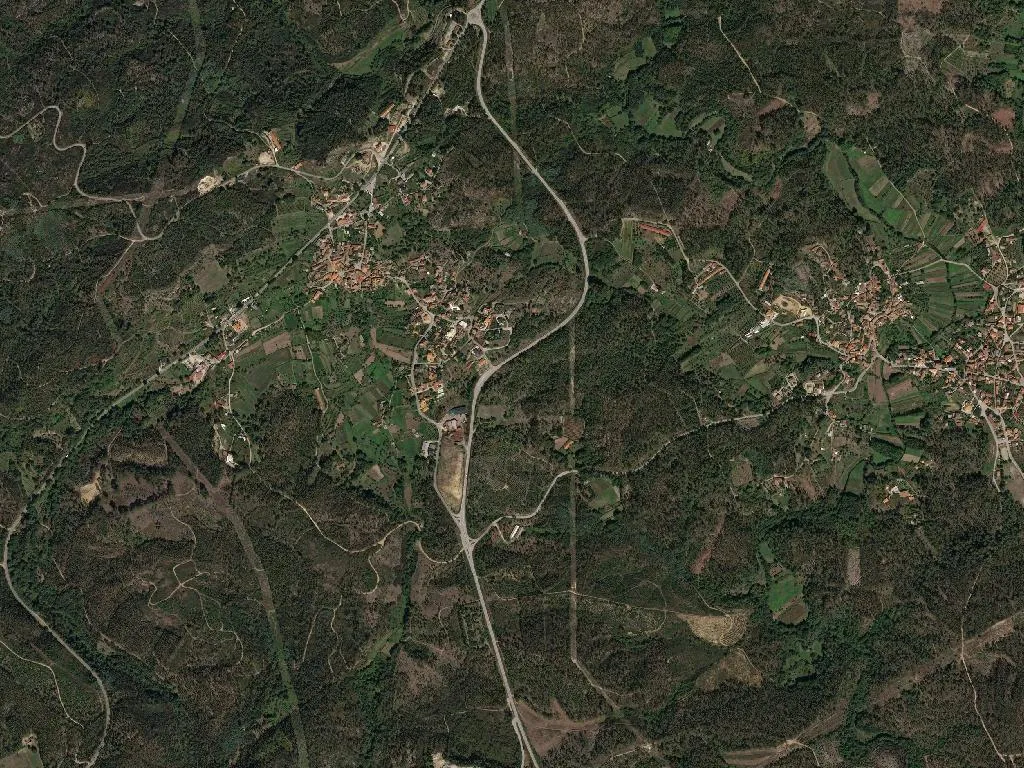
Full article about União das freguesias de Caparrosa e Silvares
Granite streams, 1521 calvary, clay-pot chanfana—Tondela’s quiet union of two hamlets
Hide article Read full article
Water, stone and olives
The stream tumbles over a staircase of granite slabs, sending up a soft percussion that ricochets off the schist walls. Beside it, the Caparrosa mill keeps its wooden wheel motionless; water still races beneath, but the stones that once crushed olives have been silent for twenty years. The scent of damp rock mingles with wood-smoke drifting from nearby chimneys. It is 9.30 on a January Friday, and the civil parish of Caparrosa e Silvares wakes slowly – 819 souls across 19 km² of newly-pruned vines and olive terraces that climb to 600 m.
Two villages, one council
Parish business is handled in Caparrosa, inside the old primary school that closed in 2009. Silvares, 2.5 km east, keeps a second office open only on Wednesdays. An administrative merger in 2013 formalised what the N230 road had always implied. The Rede Expressos bus between Viseu and Santa Comba Dão still stops twice daily – except Sunday, when it doesn’t stop at all.
The granite calvary at Silvares has surveyed the crossroads since 1521; turn up and read the plaque – there are no guides, no turnstiles. The chapel of São Sebastião shelters eighteenth-century azulejos in the Pombaline style, but its key turns only on Sunday morning. Paço da Lage, a private manor whose coat of arms is just visible above the locked gate, remains exactly that – private.
Where to eat
Caparrosa’s single restaurant, O Cantinho, serves chanfana (goat stew slow-cooked in a black clay pot) on Wednesdays and Saturdays, strictly by reservation. The lamb is genuine Serra da Estrela DOP, trucked 20 km south from Carregal do Sal. Quinta do Borgel will open its cellars and olive press for pre-booked tastings ([email protected]). In Silvares, Pastelaria Silvarence operates from 7 a.m. to 7 p.m. daily except Monday; the requeijão sweets disappear before lunch.
What to do
The Caminho do Dão way-marked trail covers 11 km from Caparrosa to Tondela, brushing past the unsupervised river-beach of São Gião. Ash and willow shade the path; bring binoculars for grey herons on the gravel bars. Between April and October the Lagar de Caparrosa presses olives on Saturday afternoons (€3, including bread and a pour of just-pressed oil); outside those months the water supply is too thin to spin the stone.
On full-moon, cloudless nights, flakes of mica in the schist flash electric blue – locals call them the "luzes azuis". Ignore the ruined Casa do Cimo: the floors are gone.
When to go
January and February bring snow above 500 m and a skeletal bus timetable. August packs the river-beach with families escaping Viseu’s heat. November’s Noite da Castanha is the parish highlight: bring chestnuts to roast, the council supplies the wine.
By 4.30 p.m. the school bus has come and gone; the church bell tolls four times – village code for a neighbour’s passing. The mill-wheel stays still, but the water keeps running, ferrying last year’s leaves downhill towards the Dão.