Full article about Dardavaz: Where Dão Valley Smoke Rises from Schist
Tondela’s near-empty parish of slate-roofed hamlets, vine seams and wood-oven corn-bread
Hide article Read full article
Where the Dão folds into the foothills
Late-afternoon sun prints oak-shadow calligraphy across the tarmac as it coils between folds of land. Ahead, the dark schist houses of Dardavaz rise out of the slope as though geology itself had decided to live here. A single plume of wood-smoke climbs, ruler-straight, into the hush. Silence, in this parish, is not absence but invitation: the hush lets you hear the stream gossiping two fields away, a dog on a distant terrace, the scuff of boots on uneven cobbles.
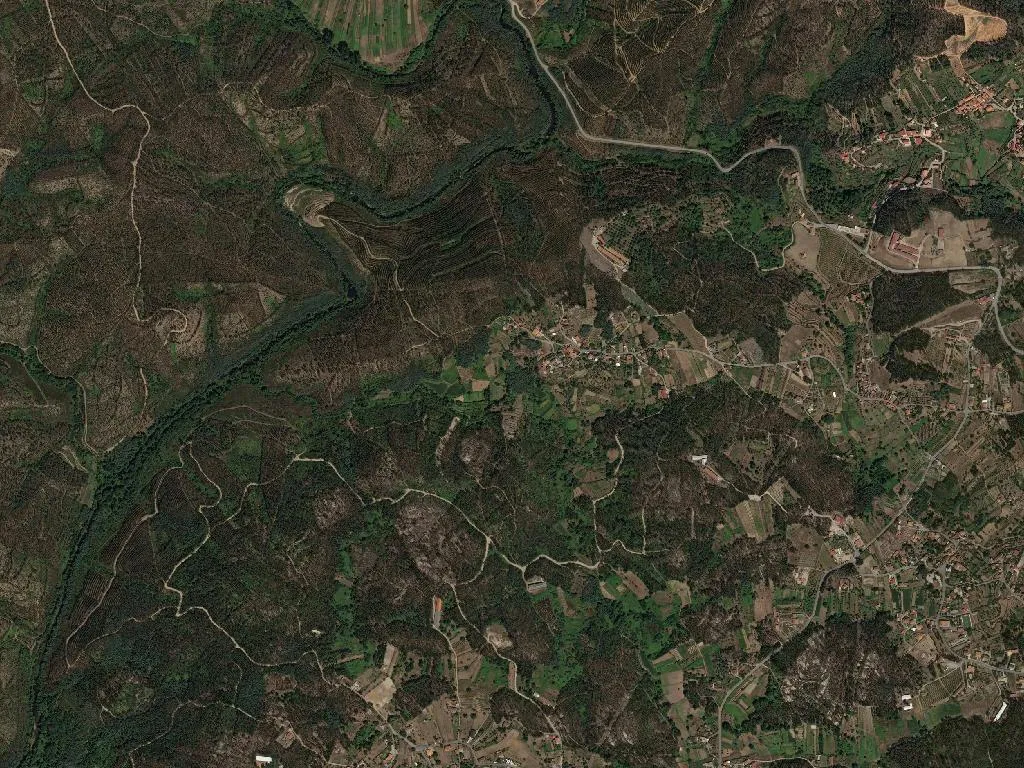
Dardavaz stretches across fourteen square kilometres of Beira Alta foothills at a modest 209 m above sea level—low enough for vines, high enough for Atlantic breezes. Only 703 people remain, scattered among hamlets whose granite-and-schist walls and low, slate-roofed doorways oblige every visitor to bow, literally, before entering. With barely fifty souls per square kilometre, distance is built into daily life: between houses, between voices, between one generation and the next.
Between vineyard and mountain
The parish sits on the outer orbit of the Dão wine region. Terraces stitch horizontal green seams into the slopes, alternating with maize plots and potato rows. In winter, fog pools in the valley bottoms like milk in a saucer while the ridge-tops bask in thin gold light. The landscape is a negotiation between Atlantic drizzle and continental heat, and the menu obeys the same treaty.
At the Padaria Primeiro de Maio, corn-bread still bakes in a wood-fired oven that warms the dark wooden counter. Push the door and steam ghosts your face; the crumb’s aroma arrives in your mouth before the first bite. On Thursdays, Celeste ferries her sister’s fresh-milk requeijão from São Joaninho—smaller than the Serra da Estrela version, but tasting of the Campo das Mós pasture where the cows graze. Sunday lunch stretches well past four o’clock, anchored by Carne Arouquesa DOP (native long-horned beef) and Serra-da-Estrelan lamb, both products of altitude and rough forage, their flavour calibrated by cold nights and wild thyme.
The weight of years
Demography here tells the interior’s familiar story: 57 children under fourteen, 246 residents over sixty-five. The streets belong to those who stayed—people who can read a surname in a stone wall, who know which dirt track leads to whose grandfather’s vineyard. When children do appear, they ricochet through alleys like swallows, watched by grandparents whose gaze is slow, exact, forgiving.
Walking Dardavaz is to feel time accrete in layers: the wear on a threshold that João Lopes still re-chisels each spring; moss on a north-facing wall where Maria da Guia hangs parsley to dry; the iron door-pull that has creaked the same minor key for half a century. Repetition is the local clock: sweeping the churchyard before the nine-o’clock Mass, watering cabbages at dusk while the Pego stream still carries enough summer melt, driving cattle to the Campo de S. Roque at first light.
As shadows lengthen, the church bell sends its bronze pulse across the valley, slipping through open windows to remind anyone listening that tempo here is set not by the calendar but by kindling smoke, by wind flattening the maize tassels, by schist that has borne centuries without complaint.