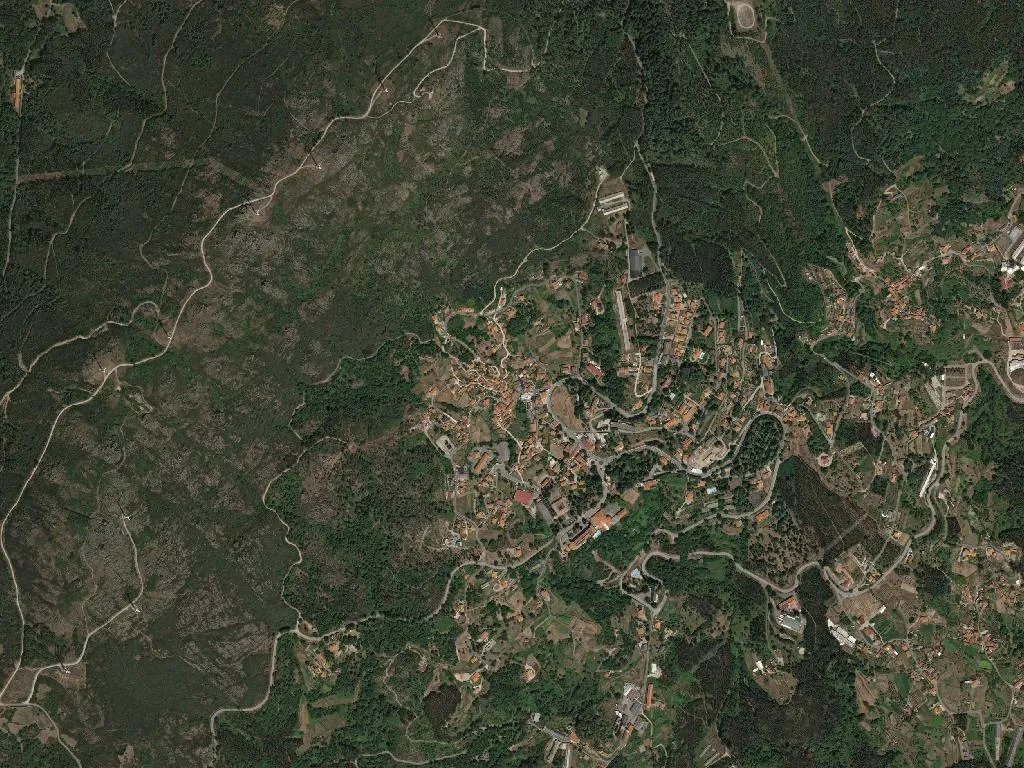
Full article about Guardão: Serra Ridge Village Above the Clouds
Guardão, Tondela, Viseu: granite ridge hamlet at 825 m with Serra da Estrela lamb, Dão wine, stone walls and 360° mountain views.
Hide article Read full article
At 825 metres, the air thins
The EN230 crests a high saddle where it meets the CM1137 and the wind has nothing to brake it. Across this tilted plateau the Atlantic air scythes uninterrupted, rattling the maritime pines and riffling the broom that edges the fields. Guardão sits squarely on the ridge: granite houses anchored to poor, schist-laced soil, horizons widening in every direction. Silence is the default setting, perforated only by a distant dog or the diesel throb of a tractor contour-ploughing a 30-degree slope.
Officially, 1,228 people live here (2021 census), but the demographics read like an elegy: 542 residents are over 65, just 76 under 15. Yet the place refuses ghost-town status. Smoke still curls from winter pig-smokers, flocks still graze the outcrops where quartz sparkles among the heather, and the stone walls—built without mortar, only gravity and skill—refuse to bow.
The mountain as larder
Guardão lies within the Dão wine zone, but vines share the stage with creatures that can walk uphill. Certified Serra da Estrela lamb (DOP) fattens on thyme-scented pastures; Arouquesa beef cattle, mahogany-coloured and horned, roam semi-wild, producing dark, marbled meat that demands four-hour stews scented with bay and garlic. Come November, the shepherds’ calendar pivots to cheese: raw-ewe Serra da Estrela DOP, curdled with cardoon, ripening into a spoonable paste with a lemon-peel bite. Slather it on hot broa, or pair the milder requeijão with pumpkin jam for a breakfast that outclasses any brunch menu in London.
Stone and light
Only one building in the parish carries listed status—testimony to centuries of scraping a living at altitude. Population density is 65 souls per km², and every hectare reminds you why: thin, acidic soils, gradients that mock the plough, winters that start in October and linger through Easter. Yet residents read the topography like scripture—knowing which spring runs even in August, which bend of the dirt track turns to axle-breaking mud.
The light up here has weight. Winter sun skims the rooftops at 4 p.m., firing the granite to copper; August heat vibrates above stubble fields, and dawn leaves every spider’s web bejewelled. Oak smoke drifts down the lanes when the first chill arrives, carrying the precise scent-memory of Guardão—earth, resin and something faintly metallic from the schist itself.
No-show tourism
There are four places to stay—two village houses, two converted barns—booked by word-of-mouth rather than algorithm. No interpretive boards, no gift-shop, no tasting “experiences”. You wake to a rooster that has no idea what a Google review is, walk trails shared only with sheep, and eat what the householders eat: smoked belly-of-pork, chestnut-stuffed cabbage, wine from last year’s barrel. Night drops like a blindfold; scattered windows glow amber across the dark valley, each one a quiet act of defiance against a land that yields its living grudgingly. The wind keeps its vigil, ferrying the smell of cold soil and woodsmoke—the unadorned signature of Guardão, no adjectives required.