Full article about Tondela’s granite Sunday: broa, bells & 1195 fair
Walk from Tondela to Nandufe along Portugal’s clearest river, past mills & oak shade
Hide article Read full article
The bell over granite: Sunday in Tondela
The bell of Igreja Matriz strikes eight, the note ricocheting off red-clay roofs and granite façades before sliding downhill towards the valley. It is the first Sunday of the month, which means only one thing: Tondela’s ancient fair is already breathing. Stalls of maize-and-rye broa circle the 16th-century pillory whose plinth still insists, in 1835 lettering worn almost smooth, “The Law is Equal for All”. Smoke from wine-marinated chouriço drifts across crates of winter cabbage; a woman in a navy apron slices Queijo Serra da Estrela DOP onto brown paper, the ivory paste slumping slowly, reluctantly, towards the waiting bread. The charter that permits all this was granted by King Sancho I in 1195—eight centuries of commerce on the same patch of granite.
When Tondela was a capital
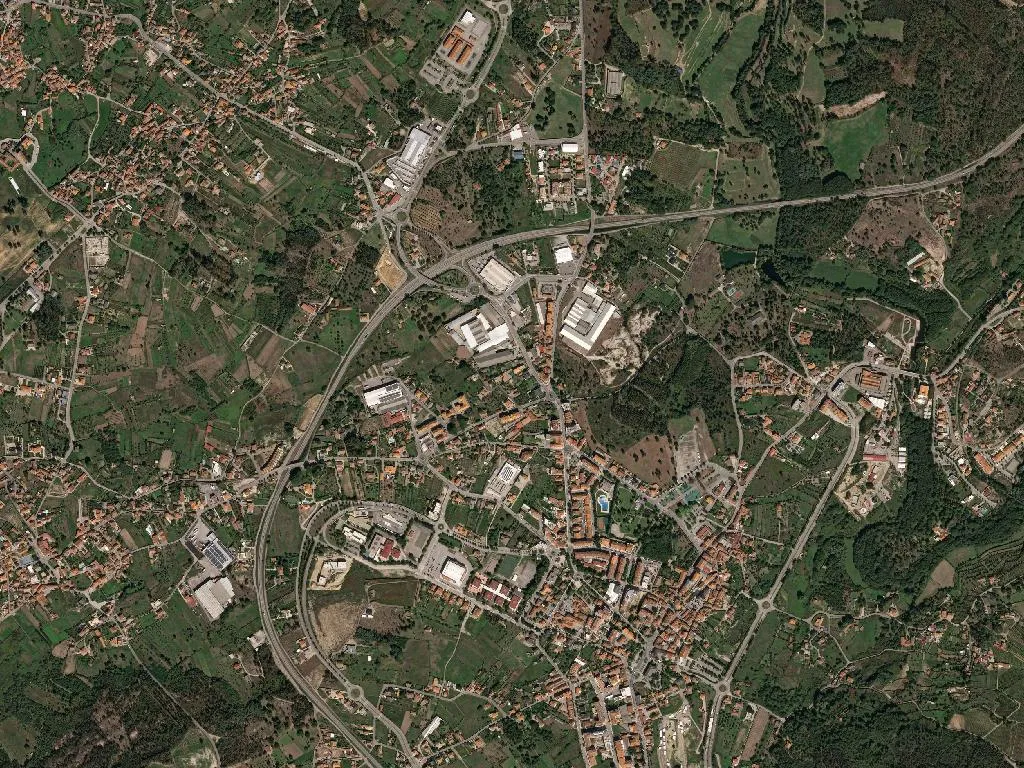
For nineteen brief years (1836-55) this market town was capital of its own district, a liberal experiment dismantled by Lisbon bureaucrats. Remnants linger: the thick-walled former town hall and jail, now the public-library reading room, and the 18th-century Solar do Conde, its stone coat-of-arms repurposed above the parish-council door. The name itself—first recorded as Tondella—hints at something round, and the old centre obeys: streets spiral towards the classified pillory, a modest granite column that once served as the municipal courtroom. Inside the parish church, mannerist gilding and 1700s cobalt azulejos glint in the half-light; outside, the tiny 17th-century St Sebastian chapel braces for 20 January, when animals are blessed in the square and a bonfire fights the coldest night of the year.
Following the Bestança downstream
A five-kilometre footpath threads Tondela to Nandufe beside the Bestança, a Dão tributary regularly cited by biologists as Portugal’s cleanest river. Water slides over polished granite, oak-alder shade flickers overhead, and the current’s low thrum becomes a metronome. Moss-darkened water-mills still channel irrigation runnels to terraced vegetable plots; a single-arched medieval bridge at Nandufe prints a perfect stone circle on the surface, as if river and mason had signed a pact. Up the slope, silence is broken only by a cockerel or the squeal of an iron gate. Granite cruzeiros—18th- and 19th-century wayside crosses—have blackened to graphite, yellow lichens mapping abstract continents. The hilltop chapel of St Anthony is kept locked; ask at the white-and-blue house opposite and Mr António will fetch the parish’s only set of keys.
Chanfana, Dão and the smokehouse
Local identity is ladled out in clay pots. Chanfela de Tondela—kid or billy-goat braised for hours in Dão red, paprika and garlic—arrives bubbling, its sauce reduced to a glossy lacquer that sticks to the fingers. Roast Serra da Estrela lamb (DOP, of course) carries the scent of holm-oak embers, while rojões beirões—pan-seared pork with greens and blood-sausage—provide winter ballast. In Nandufe, morcela de arroz and salpicão still dangle in cottage smokehouses; walk down Rua da Capela on a January afternoon and the air is thick with smouldering oak, the same wood used to cure tocino da Beira, salted and chimney-hung for months. Wines are local by reflex: Touriga Nacional reds with grip and blackberry depth; Encruzado whites flinty at 288 m above granite. The modest Dão Wine Interpretive Centre runs tutored flights that explain how schist seams colour the finish. Pudding is toucinho-do-céu, a conventual slab of egg yolk and almond, chased by a thumb of bagaceira brandy. Café Avenida keeps its own under the counter—ask for “o nosso” and Carlos will reach for the family’s post-harvest firewater.
The train that never leaves
Tondela’s river-valley terminus, once the eastern end of the narrow-gauge Dão line, is now an ethno museum. Outside, a 1907 Baldwin “American” steam locomotive rusts on rails to nowhere; inside, Antonio Lopes da Silva’s 1930s field recordings of loom clatter and wicker creak fill the air. A still-working Singer sewing machine belonged to Dona Alice, who clothed three generations of village children. Climb the adjoining Monte do Calvário (308 m) at dusk and the Beira Alta ripples away in vineyard, olive and pasture until the view dissolves into the grey halo of the Serra da Estrela. On clear days the tower of São Pedro do Sul floats above the Dão like a distant exclamation mark.
Walk back down through the silent fairground, past the pillory now stripped of stalls, and you will hear it: the Bestança murmuring beneath the granite, an obstinate, immaculate soundtrack no reforming government has ever managed to mute.