Full article about Touro: Stone, Silence & Smoke in Viseu’s High Country
Granite hamlet at 800 m where brutalist chapel meets 12th-century church amid empty ridges
Hide article Read full article
Granite blocks, mottled with mustard-yellow lichen, shoulder their way up the single-track lanes. At 800 m the air thins; a breeze climbs the Vouga valley carrying pine resin and the damp breath of mountain streams. Silence owns the village—broken only by a distant dog and the iron clack of a gate swinging shut.
Two temples, two dialects of stone
The parish church of São Miguel, a National Monument since 1910, keeps the dusk of centuries inside its metre-thick walls. Narrow slits of light pick out ex-votos—silver limbs, wax hearts—left by farmers whose fields lie a vertical kilometre below. Three hundred metres away the Chapel of São João Baptista speaks another architectural language entirely: a single brutalist prism of board-marked concrete, sliced into the ridge like a surveying instrument. Inside, shifting lozenges of sunlight slide across the raw walls, a sundial for the cognoscenti.
Five thousand hectares of elbow room
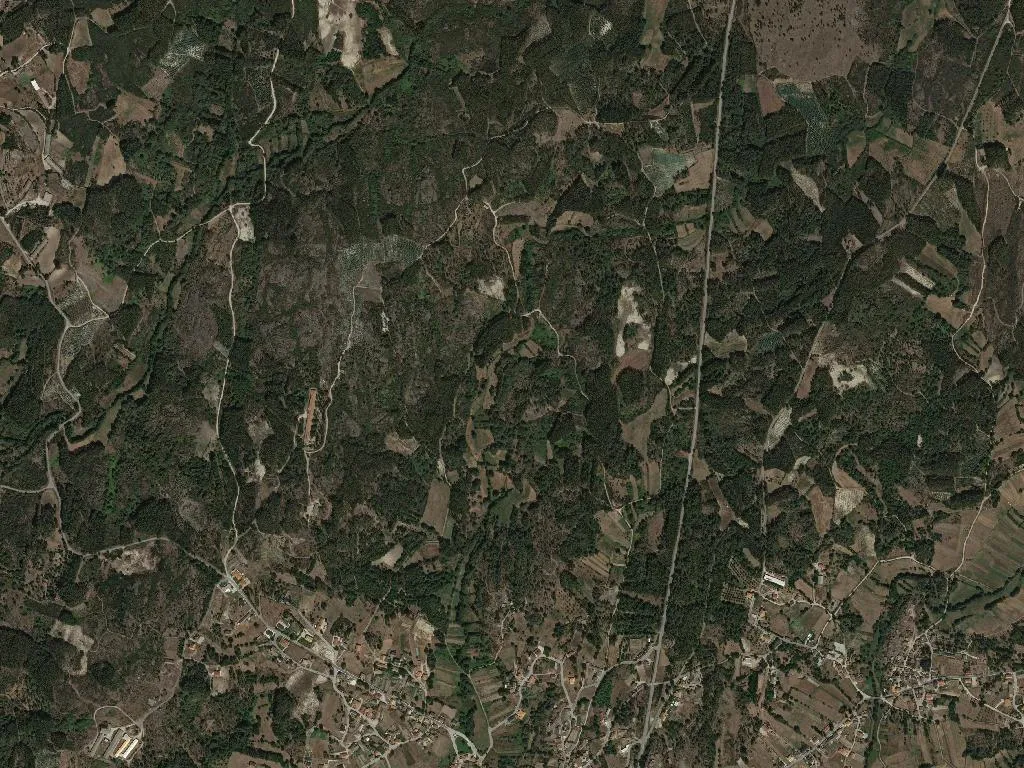
Touro’s boundaries stretch across 50 km² of Gralheira ridge—oak and maritime pine clawing at schist slopes, streams threading silver between boulders. Old shepherd paths, still way-marked by shale cairns, link the village to its satellites: Vila Cova à Coelheira, Moura Morta, Póvoa de Cervães. From the natural belvedores the view tiers westward: the Vouga basin, the Caramulo massif, then the Atlantic’s bruised horizon on clear days. Population density is sixteen souls per km²; you can walk for an hour and meet only wood smoke.
Fire, smoke and slow ovens
Communal wood-fired ovens, stoked with oak trunks, are lit every Friday. Cornbread rises overnight in clay bowls; the crust blisters to the colour of burnt umber. On feast days the ovens receive kid from the Gralheira herd (IGP) and Arouquesa beef (DOP), both reared within parish limits. The meat stews for six hours with new potatoes that drink the juices, while chorizos hang above the hearth absorbing resinous smoke. Bola de carne—suet pastry wrapped round pork and parsley—appears at Christmas, alongside pastéis de Touro, flaky wafers of conventual custard. Walk into any house built before 1950 and you’ll still find a fumeiro: hams curing in mountain air, scenting the kitchen like incense.
Festa and the arithmetic of return
On the night of 23 June the village quadruples in size. The feast of St John the Baptist draws emigrants back from Paris, Geneva, Newark. A procession shoulders the gilt statue down lanes too narrow for two tractors to pass; brass bands echo off granite like a cathedral organ. Afterward, sardines blacken over coke fires in the square, and elderly women sell shots of firewater sweetened with honey. In January, janeira singers—teenagers learning the trade—go door-to-door trading quatrains about droughts, harvests and lovers who never returned. With only 84 residents under fourteen, every baptism is a village referendum on the future.
When you leave, the smell of oak smoke lingers in your coat, mingling with wet earth and pine. It is Touro’s calling card: an olfactory signature of altitude and Atlantic weather that no city dry-cleaner will ever quite erase.