Full article about Campia: Dawn Cowbells & Oak-Smoke in Beira Alta
Arouquesa beef, granite-born Dão wine and 488 m silence in Vouzela’s high Campia
Hide article Read full article
The scent of burning logs—pine and seasoned oak—mingles with the damp-earth perfume that rises after nightfall, while dawn mist still clings to the gorse. At 488 m above sea-level, daybreak is announced by the clack of cowbells and the metallic groan of iron gates on farms scattered across 39 km² of Beira Alta. Campia wakes slowly, at field pace: first the dogs, then the hens, finally Zé’s tractor coughing into life at exactly 7.30 a.m.
The Geography of Quiet
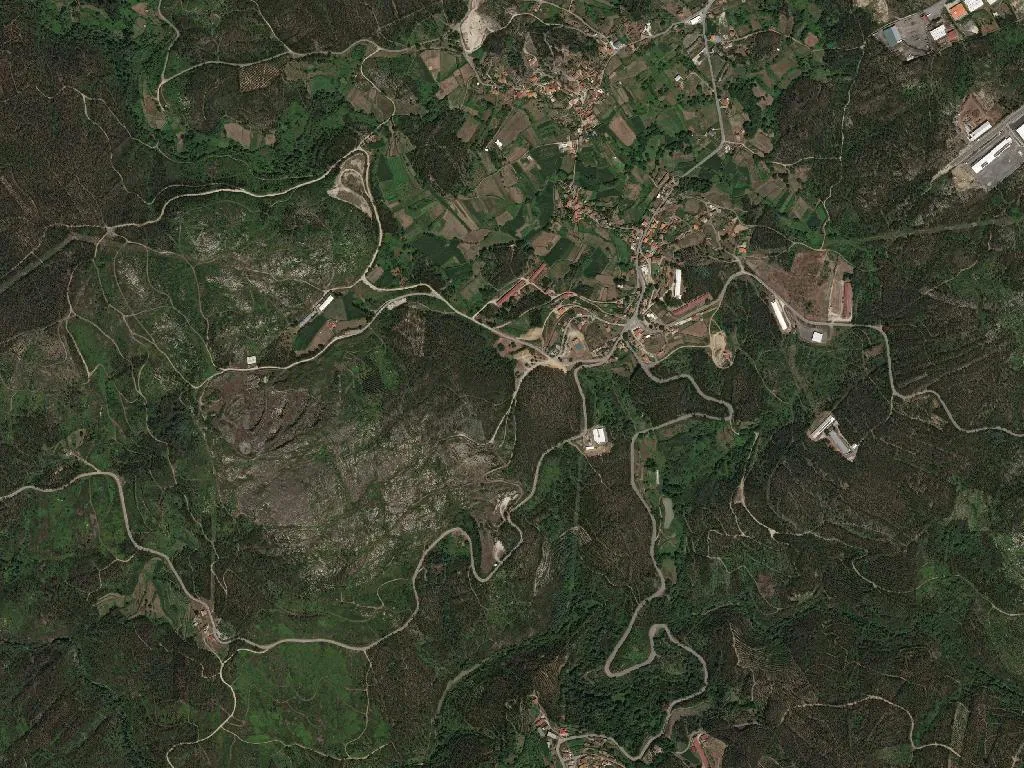
With barely 36 residents per square kilometre, this Vouzela parish unrolls as a patchwork of smallholdings, natural pasture and scrub that runs to every horizon. There are no tight clusters or claustrophobic lanes; houses sit in the landscape like benchmarks on an OS map. The scatter creates a rare sense of room, a hush so complete it feels physical, the eye always finding a green seam stitched by August sun or December frost.
The rural tracks were not laid out for hikers. They evolved from need, worn by whoever walks out to check cattle, tighten barbed-wire, carry tools. Following them is to enter a working logic—mind the puddle by Pego path, the gap Júlio still hasn’t mended in the stock-wall.
Beef that Tastes of Pasture
In these fields graze Arouquesa cattle—compact, chestnut-coated animals that spend their lives on sloping ground. Carne Arouquesa DOP is more than bureaucratic initials; it is geography you can chew: natural forage, Atlantic-moderate climate, one beast to every three hectares. The meat fibres give at the first saw-blade stroke of the knife at Ribeira’s counter, releasing a flavour concentrated enough to need nothing beyond coarse salt and Lusitanian garlic pounded in a marble mortar.
The Dão wine region wraps around Campia like a belt. Vines root into granite and schist, gifting the whites a wet-stone finish—try the quitanda’s bottle and you’ll taste it in the after-sip. Reds carry firm, fine-grained tannins; whites snap with acidity. It is no accident that pasture-raised beef and Dão wine share a table so convincingly: they are expressions of the same terrain, separated by barely 20 km of municipal road.
Time Kept by Generations
Of the 1,434 people recorded in 2021, 433 were over 65 and only 140 were children or teenagers. The figures sketch a demographic familiar to inland Portugal, yet here low density feels less like collapse than quiet persistence. Alda still bakes broa in the oven her grandfather built; António prunes olives with a billhook his father pressed into his hand in 1958.
Village DNA classifies Campia as a “culture village”—minimal risk, minimal logistical fuss. Translation: you can arrive without drama (ignore the GPS at Pedra Furada bend), move around freely, and find a place that has not been dressed as a set but simply carries on according to its own rules. The parish council still schedules festivals the old way—leitão on the spit, red wine served in clay bowls.
What Lingers
Late afternoon, when low light drags shadows across the paddocks and cold rises from the valleys, the church bell tolls the hour—thirty seconds, pause, another thirty. It isn’t performed for visitors; it is the metronome of a settlement that keeps its own time, indifferent to phone screens. That metallic note, travelling kilometres through mountain air, says more about Campia than any brochure could—especially when it blends with eucalyptus smoke drifting from hearths and the first glass of aguardente Zé presses into your hand.