Full article about Dawn smoke over São Miguel do Mato’s granite hush
Arouquesa cattle, violet-scented vines and a lane still warm from yesterday
Hide article Read full article
Smoke Ribbons at Dawn
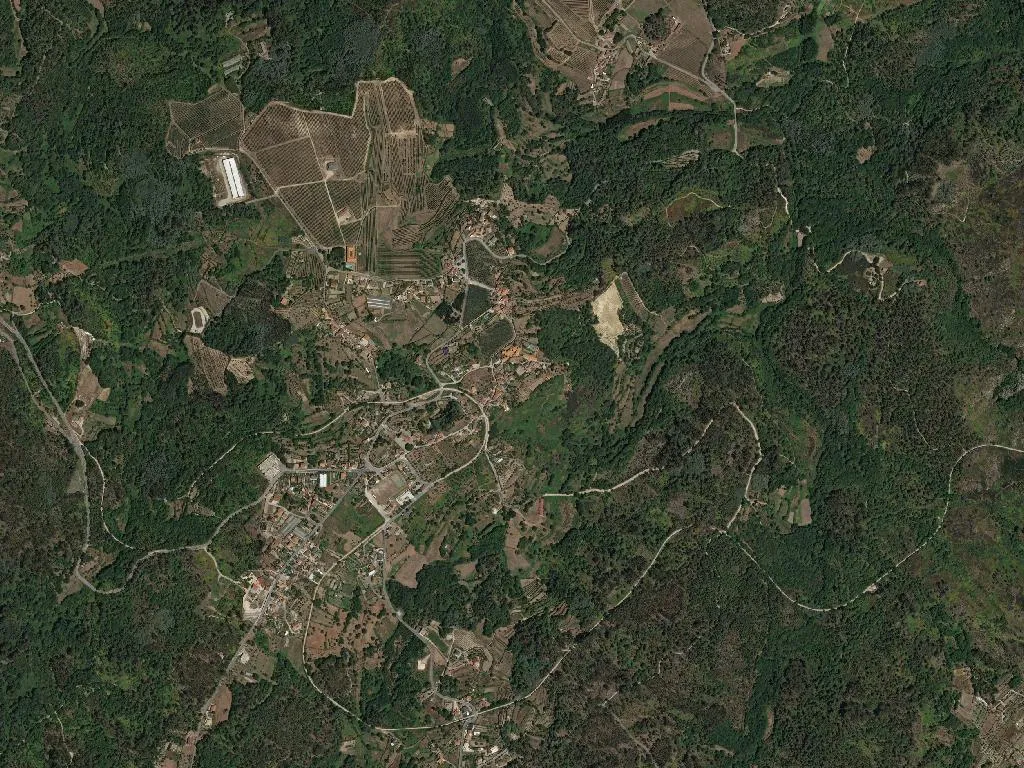
The smokehouse at Quinta do Outeiro exhales a pale grey plume that hangs motionless in the cold morning air, a vertical brushstroke above the slate roof. São Miguel do Mato wakes without haste – a dog barks once, woodsmoke seeps from chimneys, and the parish’s single cobbled lane still holds yesterday’s warmth. At 386 metres above the Lima valley, this granite thumbprint of Vouzela municipality covers barely nine square kilometres, yet its rhythms feel older than the 808 inhabitants who keep them alive.
Between Vine and Pasture
The land is terraced like a loose stack of green envelopes: lowest the rye, then the vines, finally the oak scrub where Arouquesa cattle graze. Inside the Dão demarcation, the vineyards ride narrow schist ledges above the 18th-century church, their red-blushed leaves signalling a harvest that will become Quinta da Boa Vista’s dense, violet-scented red. Below them, 450 caramel-coloured Arouquesa cows – the same breed that supplied Roman legions – move across meadows so slowly they appear to be chewing time itself. The parish’s 23 registered farmers still clip the cooperative’s ear-tags by hand, the way their grandparents did before Salazar’s wheat campaigns.
Density here is measured in footsteps: ninety neighbours per square kilometre translates to one farmhouse per hectare, each separated by vegetable plots and a footpath wide enough for a hay cart. Two hundred and sixty-nine residents are over 65; only 68 are under 14. Conversations on Rua do Fontanário last exactly as long as it takes the spring water to fill a zinc bucket, and nobody checks a watch unless they’re expecting a visitor from Viseu.
Granite, Whitewash, Silence
Houses grow from the ground they stand on. Blocks hewn from the Campo quarries form walls sixty centimetres thick – cool in August, warm when the Serra do Caramulo snow arrives. Streets were calibrated for ox-carts; a Citroën Berlingo brushes both sides. Turn a corner and you find a threshing floor turned vegetable patch, a granite shrine no bigger than a bird box, a window shutter the colour of overnight milk.
The parish church, dated 1758 on its south portal, keeps its original rococo altarpiece gilded with Brazilian gold. On weekdays the only sound is the plane tree dropping leaves onto the graves of men who died in Mozambique and returnees who never left again. At noon and seven the bell tolls the Angelus, a bronze note that rolls down the valley until it meets the river and dissolves.
Eating the Calendar
There is no restaurant. Instead, Maria Armanda braises Arouquesa shin for four hours in last year’s wine, adding winter-kale that tastes of frost and smoke. Dessert is a roasted Dão pear whose flesh has absorbed the oven’s eucalyptus embers. The meal begins when the meat is ready and finishes when the sun has left the table.
Registered accommodation totals two: Casa de Campo, a former schoolhouse where the blackboard now lists check-in times in chalk, and Quinta do Vale, whose stone tank once held olive oil and now holds a plunge pool. Reservations are made by speaking to José under the chestnut tree; he will tell you whether the key is under the flowerpot or with Dona Elvira opposite. There are no queues, no QR codes, no minibars – only the possibility of absolute quiet.
As the light tilts, granite façades turn the colour of burnt cream. Mr António’s smokehouse still issues its steady signal; cattle file through a gate that squeaks on a single, well-oiled note. The village shop shuts with the thud of seasoned oak, and the metallic snap of the bolt travels the length of the street. On the tongue: the iron-cold water of Fonte da Broca, a taste that cancels distance and tells you, bluntly, that you have arrived exactly where you are.