Full article about Arroios: Lisbon’s world in one breath
Cumin-scented lanes, 40 tongues, naan and custard tarts under Art-Déco balconies
Hide article Read full article
The aroma hits before the view. Roasted cumin, green coriander and cardamom drift through a cracked-open door on Rua do Benformoso – barely 500 metres of granite cobbles where forty-plus languages are traded before you reach the zebra crossing. A radio somewhere between 87 and 89 FM leaks kizomba at conversation volume; across the street a just-baked naan shares a shop window with milk bread and a custard tart whose blistered skin shivers in the draft. We are 61 metres above sea-level, dead-centre of Lisbon, yet every corner rewrites the mental map.
Arroios never announces itself with ceremony. You slip into it along Avenida Almirante Reis – a turn-of-the-century boulevard that once sliced through market gardens to link Martim Moniz with the northern suburbs and still behaves like the parish’s spine. Morning light pings off Pombaline tilework and wrought-iron balconies, igniting ochre and wine-green facades the years have crazed but never dulled.
The rivulets that no longer run
The name remembers water. Before the grid arrived, runnels tumbled down the hill to the Tagus, feeding orchards and public washhouses. They vanished beneath asphalt but survive in street names and local memory. Organised settlement began in the mid-16th century when Igreja dos Santos Anjos went up in 1551 and Convento de Santana opened eleven years later, anchoring commerce inside their walls. Today’s parish – carved in 2012 from the former Anjos, Pena and São Jorge de Arroios – inherited a tight mesh of lanes that gradually broadened into the early-1900s bourgeois quarters: Andrade, England, Azores, Colonies. Art-Déco and early-modern villas still elbow rental blocks, their carved stone and screeching iron gates intact.
A library, a lookout, a playground painted by a graffiti star
São Lázaro public library opened in 1883, the city’s first. Behind its sober neo-classical stone, the hush is almost monastic, broken only by the soft thud of date stamps. Five minutes south, Braamcamp Freire garden – two hectares on the Campo dos Mártires da Pátria – offers a different retreat: ducks gliding between lily pads, veteran trees sieving daylight into green dusk, and a multi-sports court splashed by Lisbon artist Akacorleone in cobalt, tangerine and magenta cubes that seem to levitate from the concrete.
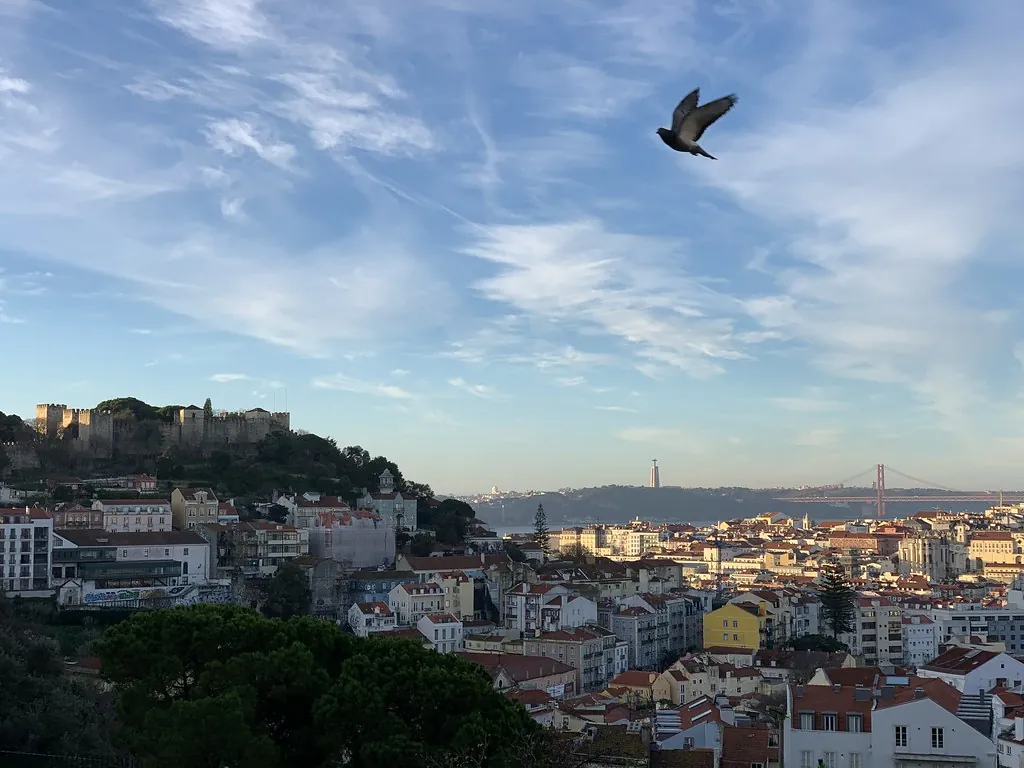
Climb further and Monte Agudo viewpoint unfurls 1.2 hectares of lawn and esplanade with roof-top views clear to the river. A 1950s tile panel by Swiss graphic designer Fred Kradolfer – the man who shaped Portuguese advertising typography – frames the skyline in cobalt brushstrokes on white, as though the city needed a mount.
Eating the atlas
A meal in Arroios is a round-the-world ticket with the same postcode. At Ramiro, the shellfish institution, regulars queue at 17:00 before the tidal wave hits; Bulhão Pato clams arrive in clouds of garlic and coriander. Walk five minutes and Terrapão’s 24-hour sour-dough perfumes the doorway. Fox Coffee dishes out Cape-Verdean cachupa; O Covil drizzles Hungarian honey cake; Mabiche fires Marseille-style pizza; Papagaios remixes brunch tropes. On the same block Bangladeshi, Nepalese, Indian and Pakistani tandoors blacken iron pots while naan lands tableside still smoking. The parish sits inside the Lisboa wine region, so don’t be surprised to see nomad coders pairing a glass of local white with DOP Azeitão sheep cheese or Alentejo ham – stocked by upmarket grocers and the revamped Arroios market, now a weekend stage for food fairs, concerts and inter-cultural stand-offs.
Fifty-seven kilometres of pavement
Arroios compresses 57 km of roadway into 2.1 km² – a density your feet will testify to. Walking is the only working algorithm, from the Military Academy’s stern stone façade on Rua Gomes Freire to indie bookshops Piena, Tigre de Papel and Leituria, where uncut pages smell of fresh ink. Thread four separate Santiago routes (Coastal, Inland Via Lusitana, Torres, Fátima) without noticing – here pilgrimage is simply crossing the road between a halal grocer and Mustarda’s burger kiosk. Time Out crowned it the world’s coolest neighbourhood in 2019; The New York Times listed it as a cultural must. Census 2021 counts 33,302 souls: 6,675 over 65, 3,456 under 15 – a demographic sandwich of beret-clad grandfathers and Eritrean teenagers waiting for the 735 bus. The 1,111 registered short-term lets prove the world also wants to sleep here.
The note that lingers
Late afternoon, when low sun lacquers Almirante Reis tiles amber and traffic exhales, a second-floor window releases the low growl of an Indian harmonium rehearsing a late-afternoon raga. The note holds, vibrates against 1920s lime plaster, then braids with starlings wheeling above Braamcamp Freire. That improbable chord – a Punjabi instrument answering 18th-century masonry – is Arroios distilled: no slogan required.