Full article about Avenidas Novas: Lisbon’s ruler-straight Parisian dream
Plane-tree shadows stripe wide boulevards lined with 1900s palaces and Art-Deco friezes
Hide article Read full article
Avenidas Novas: Lisbon Drawn with a Ruler and Set-Square
Morning light slips diagonally through the plane-tree tops on Avenida da República, printing crisp shadows across a pavement wide enough for four prams abreast. The rhythm here is unlike the old city: no lanes that buckle like bent wire, no limestone rubbed translucent by centuries of shuffling. Instead, façades stand to attention along rectilinear blocks, four- and five-storey buildings wearing wrought-iron balconies and dressed-stone cuffs, the air moving with an amplitude the central hills never allowed. This is a city conceived on tracing paper before it touched stone, and the tension between blueprint and lived experience gives Avenidas Novas its particular texture.
The Engineer’s Grid and the Parish Born from an Advert
In the 1880s, engineer Ressano Garcia sketched an orthogonal mesh of broad avenues north of Entrecampos, dreaming of a Lisbon that could breathe like Paris or Berlin. The name “Avenidas Novas” did not come from royal decree; it was coined by an 1890 newspaper campaign flogging plots of former farmland. Lisbon’s gentry took the bait, commissioning neo-Manueline mini-palaces such as the 1901 Palacete Mendonça, all twisted rope mouldings and mini-turrets that look as if the Age of Discoveries had been filtered through fin-de-siècle nerves. Over the next half-century, architects—Norte Júnior, Ventura Terra, Porfírio Pardal Monteiro—layered on Art-Deco friezes, gilt stucco, iron-and-glass portals, tiles that shimmer under Atlantic light. The parish was only formalised in 1959, yet it already protects 26 listed buildings: six of national importance, fourteen of public interest, a dense inventory for a rectangle of barely three square kilometres sheltering 23,000 souls.
Iron Domes and Gold Mosaics
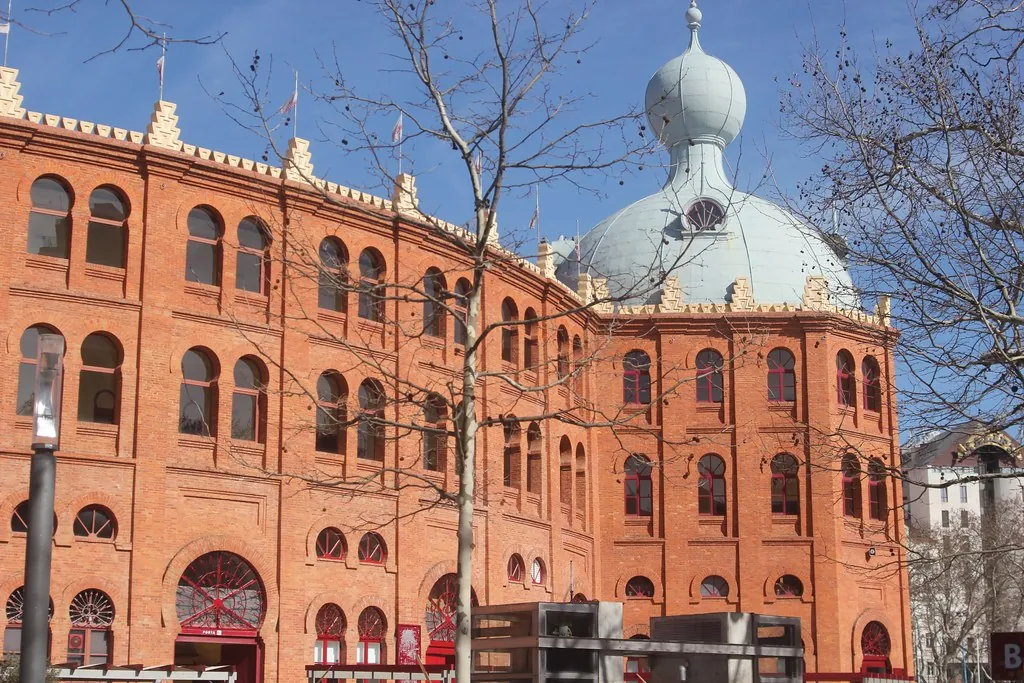
Two structures fix the skyline. Campo Pequeno bullring, opened in 1892, wears a Moorish dome of bolted iron panels that can be removed with cranes; at dusk its red-brick towers drink in the copper sky. Today the arena hosts Rod Stewart concerts and craft-beer festivals, footsteps echoing like cathedral whispers. Five blocks east, the 1953 Church of Our Lady of Fátima hides a crypt lined with gold, lapis and ochre mosaics by Querubim Lapa—Portugal’s answer to early Chagall—turning the half-light into a horizontal stained-glass lake. On 13 May and 13 October, processions still spill from its doors, candles guttering against the diesel breeze. Nearby, the Palace of the Counts of Carnide—now the district town hall—contains Lisbon’s only oval salon, modelled on Mafra: a room so acoustically perfect you hear the 18th-century floorboards sigh before you see them.
Glasshouses, Lawns and a Sundial that Keeps its Word
Perched at 75 m above sea level—Lisbon’s own plateau—Avenidas Novas unfurls 26 hectares of precisely clipped grass in Parque Eduardo VII. Inside a disused quarry sits the Estufa Fria, a cool greenhouse where tree ferns, camellias and orchids drink mist filtered through lath slats; next door, the Estufa Quente shelters cacti whose spines turn translucent in mid-afternoon sun. At the park’s summit, a 1917 analemmatic sundial tells true solar time to the minute—arguably the capital’s most honest clock. From here, the eye slides down a green corridor to the Tagus, São Jorge Castle snipped from silver haze. Head north and Campo Grande lake offers rowing boats and a 2.7-kilometre cycle loop—an improbable pocket of deceleration in a quarter that packs 7,800 residents per square kilometre.
The Long Table of Avenida da República
Since 1922, Pastelaria Versailles has kept its brass chandeliers, bevelled mirrors and stucco garlands; order a custard tart whose shell shatters like thin ice, or a slice of Tentúgal pastel de nata IGP—puff pastry so fine daylight glows through it. Pair it with a chilled Arinto-Fernão Pires white that tastes of sea-spray and limestone. Gourmet grocers along the same avenue sell Serra da Estrela DOP cheese, orange-rinded and runny at room temperature, and hand-carved Barrancos ham, sweet with acorn perfume. Shelves also hold Aveiro ovos moles IGP and Ovar sponge cake, ambassadors from other provinces adopted by a neighbourhood that functions as the nation’s larder window.
Voices Still Caught in the Plaster
Fado singer Carlos do Carmo, who lived just off Avenida de Roma, gave the district its soundtrack—his baritone seems to linger in the lift-shafts. Novelist Urbano Tavares Rodrigues captured 1950s life here: tobacco fug in cafés, trams screeching round curves, a middle class inventing itself under Estado Novo rent controls. Porfírio Pardal Monteiro’s 1952 headquarters for the Diário de Notícias—streamlined concrete and horizontal glass bands—remains a manifesto of forward-looking Portugal. Descend into São Sebastião metro and you walk through 2,500 m² of Maria Keil azulejos: cobalt, chalk and sea-green fields that turn the platform into a living canvas.
At dusk, the sundial’s shadow stretches across warm stone on Eduardo VII’s miradouro. Below, the Tagus turns gunmetal, and for a moment the air carries both the green breath of the glasshouses and the hot diesel of buses idling at Marquês de Pombal. That collision—botany and asphalt, earth steam and exhaust—clings to the skin of anyone who wanders these avenues someone dared, more than a century ago, to call “new”.