Full article about Parque das Nações: Lisbon’s River-City Born from Expo Rubble
Parque das Nações turns Interporto rust into riverfront wonder: Europe’s biggest tank, Expo relics, Tagus views and smooth reclaimed promenades.
Hide article Read full article
Where the Tagus Became a City
The wind announces itself before anything else. Salt-laden, cool, it carries the damp breath of a river wide enough to feel tidal. Only after the air arrives do you notice glass, steel, concrete: a skyline that barely existed thirty years ago. Morning light ricochets off the Tagus in white shards so bright you squint, half-blind, like someone stepping from a cinema into noon. Beneath your feet the promenade is flawless – no lumpy Lisbon cobbles here – and that smoothness is the first clue: this ground is reclaimed, invented, barely older than a millennial.
Built on Barges and Forgotten Yards
Until 1998 the district was the Interporto – a rusting apron of warehouses, railway spurs and silos where the “Branch Line to the Sea” ended literally inside floating barges. Trains slid straight into the hulls, grain pouring down steel chutes like something from a Soviet newsreel. When the city won Expo ’98 – theme: “The Oceans, a Heritage for the Future” – every square metre was re-drafted. Dredgers uncovered a sixteenth-century shipyard; you can still see its timbers in the small archeological nucleus under the Oceanário. The parish itself was only signed into existence in 2012, carved from the industrial parish of Santa Maria dos Olivais, yet its identity had already been fixed during that exhibition summer when three million visitors walked boardwalks that smelled of fresh pine and salt.
Calatrava, Siza and Five Million Litres of Ocean
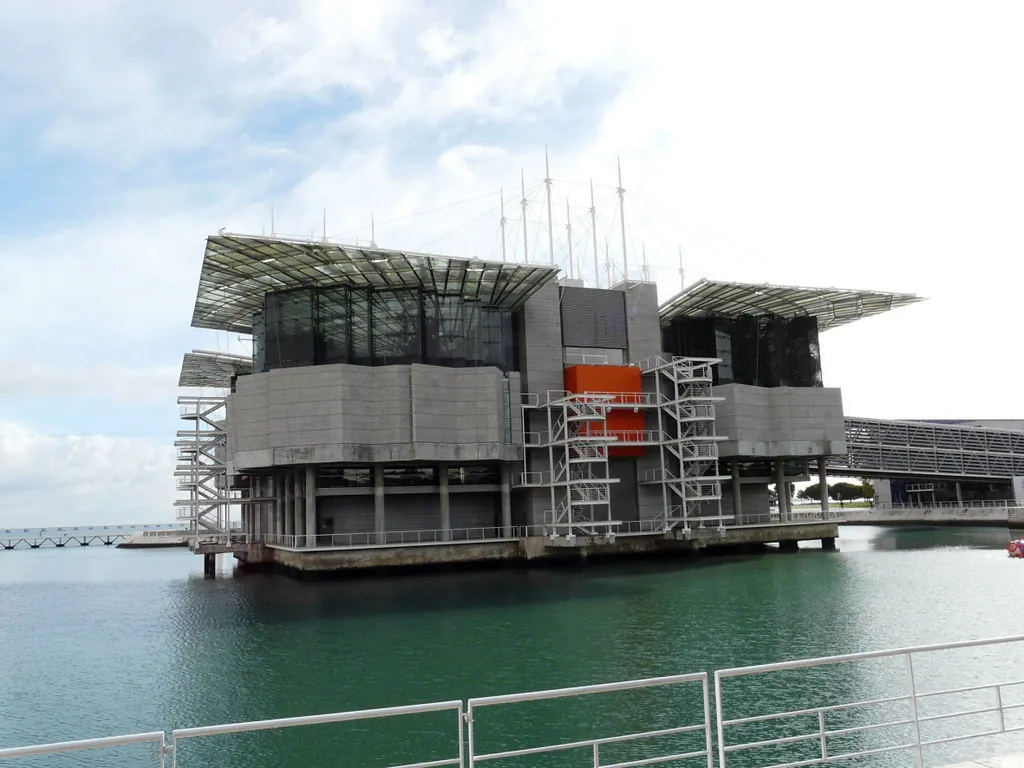
Oriente station, Santiago Calatrava’s vaulted “forest” of white ribs, throws geometric shadows across the high-speed platforms; commuters flow beneath it like disciplined schools of fish. Five minutes away, Álvaro Siza’s Portugal Pavilion hovers a razor-thin concrete canopy the length of a football pitch, weightless as origami. Between them, the Oceanário – now a listed Monument – contains Europe’s largest single tank: five million litres of salt water engineered to mimic one continuous global ocean. The lighting is submarine indigo; the only sounds are the bass thump of pumps and the occasional slap of a grey shark’s tail against acrylic. Outside, the 145 m Vasco da Gama Tower skewers the sky, while a nineteenth-century harbour light at Doca dos Olivais keeps watch like a retired sea-captain. Sculptural tributes to the Discoveries punctuate the promenade – bronze caravels, compass roses, astrolabes – but they feel curated rather than nostalgic, museum pieces in an open-air gallery of modernity.
Flamingos on Concrete
Nature, stubborn, insists on joining the experiment. The parish lies inside the Tagus Estuary Natural Reserve; the Trancão River slips in here, forming brackish lagoons where roseate flamingos balance on graphite-coloured legs, oblivious to glass office blocks. Swallows stitch between reeds and CCTV poles. Garcia de Orto garden, named after the sixteenth-century botanist, palms fronds from Angola and Brazil beside the Iberian oaks, a living index of imperial plant-hunting. Rent a bike at the station and the riverside cycleway unrolls for 5 km; the estuary widens until you can no longer see the opposite shore, only a low line of container cranes dissolving into haze. From the cable-car, 30 m above, the city’s roofscape resembles a scale model – terracotta roofs on the old side, photovoltaic panels here.
Crab, Azeitão Cheese and Hyper-local Lager
On Saturdays the pop-up market in Jardim do Passeio dos Heróis do Mar smells of smoked Alentejo sausage and Queijo de Azeitão DOP, its runny centre scooped onto brown paper with a plastic spoon. Try the custard tarts from Alfeizerão and a thimble of Moscatel de Setúbal while you queue for a paper tray of percebes (goose barnacles) steamed in seawater. Permanent restaurants range from textbook marisqueiras – order the stuffed brown crab, the monkfish rice, the clam cataplana – to José Avillez’s Bairro do Avillez, where Iberian pork meets kimchi and the house G&T arrives with a drift of smoked rosemary. Lisboa Brewing Co. ferments two kilometres inland; its citrusy Session IPA tastes better still when the sun flattens the river into molten copper and the Myriad hotel’s 23rd-floor terrace starts pouring post-work spritzes. Later, Ana Moura’s fado house inside the casino adds a necessary note of saudade to a neighbourhood that was, until recently, architecturally too young to feel melancholy.
Parish Day and the Art of Inventing Tradition
With 22 400 residents – more under-14s than over-65s – the quarter celebrates its official day on 25 November with science workshops in the Knowledge Pavilion rather than processions. The annual Lisbon Fish & Flavours festival (April) turns the waterfront into a roaming degustation of oysters, sea-urchin toast and vinho verde poured by the glass. Every other autumn the park hosts “Around the World in 80 Days”, a weekend when Angolan kuduro, Indian dosa stalls and Brazilian capoeira circles reclaim the boulevards – a conscious echo of the multicultural brief the Expo gave the city.
At dusk, walk east until the towers thin out and the only sound is the hush of bicycle tyres and the whistle of a tern diving for fry. The Tagus turns bronze, then pewter, negotiating the same boundary it has always kept: half river, half sea. Parque das Nações was dreamed up on spreadsheets and cranes, yet every tide reminds it who remains in charge.