Full article about Sousel: Marble Manueline Doorways & Cardoon Cheese
Sousel, Portalegre—marble Manueline mansions, cardoon-set ewes’ milk cheese, cork-oak plains and silence under storks.
Hide article Read full article
Whitewash against cobalt
The white lime of the houses cuts a clean line through the Alentejo’s saturated sky. Sousel sits on a gentle swell of high-plateau land at 200 metres, its silence the sort earned by watching centuries settle into stone. Afternoon heat pools in the grid of narrow lanes; eaves cast slender bars of shade contested by cats and by anyone sensible enough to walk slowly. With 1,783 souls spread across 90 km², time is measured in wingbeats of storks, not in minutes.
Houses that remember names
The architectural story clusters around Praça da República and the adjoining web of cobbled alleys. Solar dos Pachecos, on Rua de Santo António, still flaunts a Manueline doorway carved from local marble and a coat of arms eroded by wind and politics; inside, a vaulted courtyard drops the temperature by five degrees and 18th-century azulejos flicker cobalt behind a stone fountain. Across the square, the parish church of Nossa Senhora da Expectação anchors the skyline with a single bell tower. Step through its walnut doors and daylight falls in precise golden slabs across basalt flagstones; the only soundtrack is the occasional creak of a kneeler and, somewhere beyond the sacristy, the soft thud of the sacristan’s door.
Cheese that travels
Sousel belongs to two protected cheese territories. The ewes that graze the surrounding cork oak savanna (montado) produce the raw milk for both Queijo de Évora DOP and the younger, milder Queijo Mestiço de Tolosa IGP. At Queijaria O Ginete, 3 km west of town, coagulation is still triggered by wild cardoon thistle, curds are hand-ladled into linen-lined moulds, and wheels spend two months breathing on rough-pine shelves. The result is a compact, straw-coloured cheese with a vegetal bite that pairs best with a slice of dense-crumbed Alentejo bread and a mouthful of chilled red.
Winter comfort food arrives in the form of açorda—garlic-coriander broth poured over yesterday’s loaf—and ensopado de borrego, lamb stew thickened with mint and home-made bread. Black pigs, fattened on acorns beneath the same holm oaks, reappear as mahogany-hued chouriço and paio, smoked for three weeks over evergreen oak until the fat glistens like polished chestnut.
Breathing room
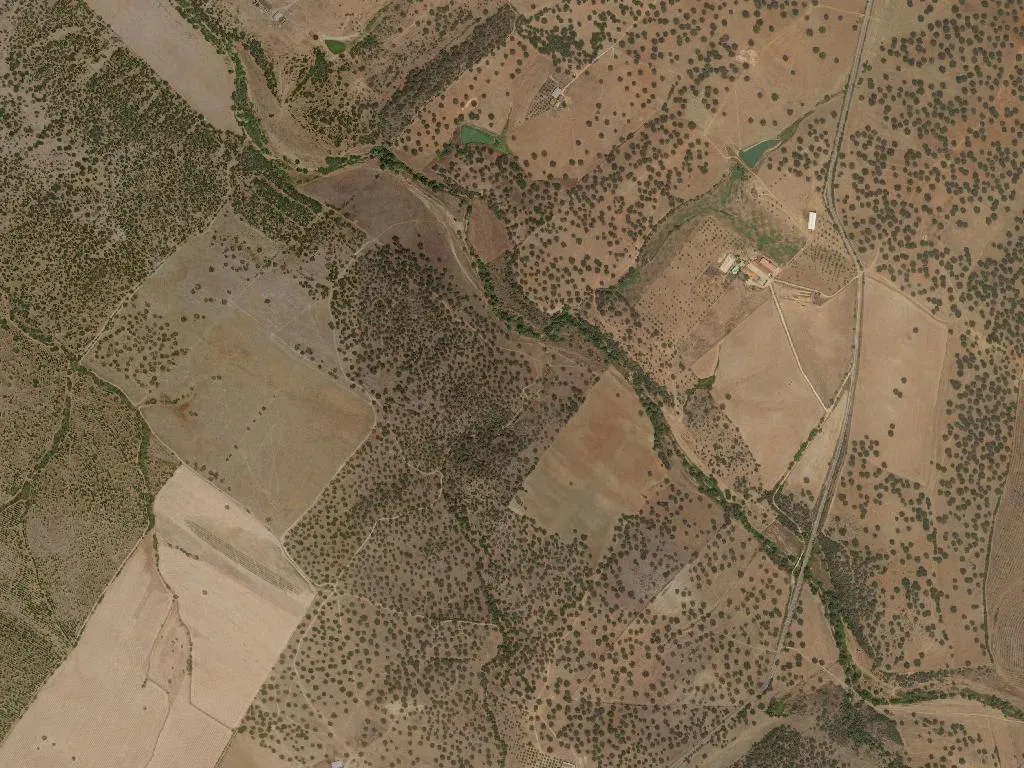
Beyond the last house the land unrolls in slow motion: wheat fields that shrug from emerald to gold to stubble, and cork oaks scattered like punctuation marks. There is no ridge, no sudden valley—just horizon in every direction. The 8-km Trilho dos Moinhos loops out to the gaunt stone cylinders of three 19th-century windmills; skylarks stitch the air above, and the only walls are hedges of strawberry tree and hawthorn. Dawn light skims the cereal heads sideways; by noon the sky is a white kiln; evening returns everything to a honeyed glow.
Sit on the granite bench beneath the 800-year-old olive tree at Herdade das Argolas and the plateau feels like a private continent. Rosemary scent rises from warm soil, a black-shouldered kite hovers overhead, and the hush is so complete you can hear your own pulse. Sousel doesn’t ask to be explained—only to be borrowed for an hour or two.