Full article about Alpiarça: where the Tagus plains toast into eel-rich stew
Casa dos Patudos, baroque church and river kitchens rise from Portugal’s tabletop lezíria
Hide article Read full article
Alpiarça, where the meadow breathes
The heat shimmers above the soil in visible ripples. Not a single contour interrupts the horizon; only the Tagus, somewhere to the south, has the authority to bend this tabletop of alluvium. At 33 m above sea-level the air is thick with the smell of wet clay, scythed reed and the faint iron tang of irrigation ditches. You do not look down on Alpiarça – you move through it, at the same height as the rice shoots and the low, black trellises of vine.
A republican’s bequest to the nation
Every approach to the village funnels past the gates of Casa dos Patudos. One moment you are among sun-blistered cottages with ox-blood doors; the next, a 1901 neo-Moorish manor erupts from the plain, complete with topiary tunnels and a Wellingtonia that could shade a cricket pitch. José Relvas – finance minister of the fledgling Portuguese Republic, compulsive collector – built it as a live-in archive: Sèvres porcelain, 17th-century Dutch cabinets, a library that still exhales the feral sweetness of old vellum. When the state inherited the house in 1929 part of the hoard went to the National Museum of Ancient Art; what remains is Alpiarça’s only cultural turbine. Locals call the place “Patudos” after the family mastiff whose paws were the size of saucers – the dog, the dam, even the local football team still carry the name.
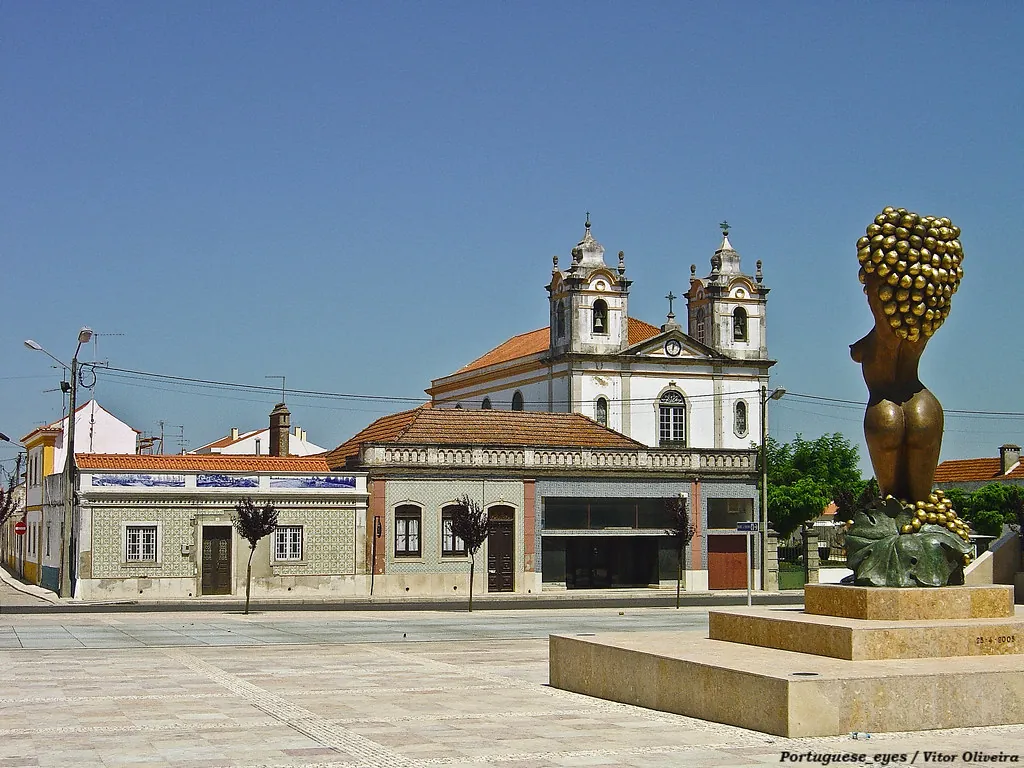
In the village centre the parish church of Nossa Senhora da Conceição lifts a baroque façade above a square where pigeons squabble over crumbs of bolo de azeile. Inside, 1700s gilt carving glints through a haze of incense and dust motes. A three-minute walk away, the Manueline-brick Capela de São Sebastião completes the trio of monuments the village guards with unshowy pride.
The thick taste of the lezíria
Cooking here starts at ground level. Eels slip through the Tagus sluices; purslane colonises the field margins. Together they become ensopado de enguião – a coriander-heavy stew that tastes of green rivers – and sopa de baldroegas, a sharp, vegetal broth that makes the tongue tingle like sorrel. Lamb is wood-roasted until the skin fires into crackling; arroz de sarrabulho carries the metallic note of pork blood slowly stirred into rice, a reminder that nothing is wasted.
Carnalentejana DOP beef, reared on the rib-wide pastures that circle the village, arrives grilled or braised, its marbling the colour of old Sèvres. Dessert is bolo de azeile – half bread, half pudding, damp with olive-oil sweetness – followed by ivory folds of trouxas de ovos and pastéis de feijão from nearby convents. The Tejo wine route stops here: at Quinta da Gouveia or the growers’ co-op, whites keep the snap of apple skin; reds age long enough to tame the tannins and stand up to the local iron-rich stews.
Primitive horses and silent water lanes
The Patudos reservoir, created by damming a Tagus tributary, gives the village its horizon. Paths skirt the water through reed beds where herons pause like commas. In the adjoining Parque do Carril the old irrigation levadas – narrow canals that once fed the rice paddies – have been surfaced for cyclists; their steady whisper accompanies you between rows of Fernão Pires vines and rectangles of mirror-bright water.
At the municipal boundary the Sorraia River marks the reserve that shelters one of Europe’s most improbable equines. The Cavalo do Sorraia – dun, dorsal-striped, barely 14 hands – was noticed only in 1920, grazing the marshes like a cave painting that had wandered into daylight. Today 150 or so move through the pauls in loose family bands, indifferent to the telephoto lenses trained on them from the observation hide. Watching them graze beneath a sky the size of Salisbury Plain is to understand that this meadow existed long before the first rice seed was ever dropped into it.
Good Friday’s salted cod
Alpiarça keeps time with the liturgical calendar. Holy Week processions negotiate lanes barely two metres wide, candles guttering in the draught of passing skirts. On Good Friday the village performs the Enterro do Bacalhau – literally “the burial of the cod” – a half-ironic, half-devout parade in which a coffin containing a salted fish is carried to the church, mourned, then resurrected for supper. On 8 December the Immaculate Conception turns the main street into a fairground of grilled-sardine smoke and pimba music loud enough to drown the church bells. Summer brings the Craft and Gastronomy Fair: beekeepers demonstrate wicker skeps, and dark Ribatejo honey – the colour of old mahogany – is sold from unlabelled jars that still hold the warmth of the hive.
With 6,975 souls – a fifth of them over 65 – Alpiarça is sized for walking slowly. Eighteen beds are scattered between village houses and the single guest-house: enough for anyone who wants to measure the day not by the clock but by the interval between the first bee in the rosemary hedge and the six-o’clock bell that turns the entire meadow into a sheet of liquid copper.