Full article about Santarém: Sunrise over Tagus & limestone ramparts
Storks wheel above Visigoth stones while river-mist lifts off the lezíria below Portas do Sol.
Hide article Read full article
Above the Tagus: limestone, storks and the scent of river mud
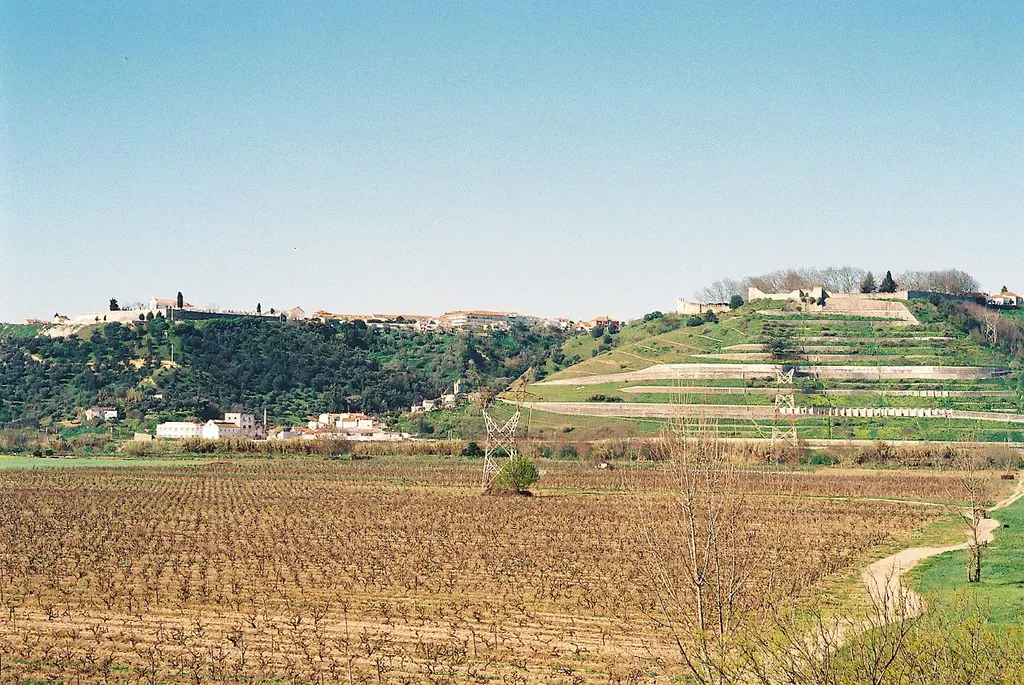
The wind that climbs the escarpment arrives in slow, damp lungfuls, freighted with silt, reeds and the metallic tang of the Tagus. From the Portas do Sol garden, dawn peels back the mist and rolls out the valley like a parchment: straw-green lezíria, ochre olives, a silver filament of river looping east towards Lisbon. Seventy-six metres below the balustrade, the water gathers and loosens in tidal breaths; above, the city’s limestone spine holds steady, a parapet that has watched every invasion since the Romans docked at Scalabis.
Santarém’s civil parish – the urban kernel of the wider municipality – numbers only 30,017 souls, yet it carries the weight of four successive civilisations in its stone. Within a ten-minute radius you can stand on Visigoth footings, trace a Moorish arch with your palm and read the 1254 charter that gave Portuguese towns their first taste of self-rule.
A city that wrote its laws in stone
Afonso Henriques finally dislodged the Moors on 15 March 1147 after a seven-week siege; the town he seized had already answered to Romans, Visigoths and a Berber garrison who called it Shamblik. Six years later the same king summoned the earliest cortes – a proto-parliament – to meet here, inviting commoners as well as clergy. The statutes drafted in the Royal Palace (today the town’s archaeology museum) became the template for municipal government across the infant kingdom. Walk Rua de São Miguel and you are treading on the parchment: the uneven calçada is the original 13th-century pavement, recycled rather than replaced.
Fifteen National Monuments in one square mile
Gothic Portugal was born here. The Igreja da Graça, commissioned in 1387 by the brother of Nuno Álvares Pereira, opens through a lace-like rose window whose late-afternoon shadow falls across the courtyard like a giant gnomon. Two streets away, the stubby Romanesque tower of São João de Alporão now shelters the town museum; inside, the marble tomb of Dom Duarte de Menezes (d. 1464) lies beneath the country’s only Hispano-Moorish tile panel north of the Alentejo. Step into Marvila’s interior and 1,587 sixteenth-century azulejos bloom around you – a blue so mineral it refuses to fade even under LED spotlights.
Above the rooftops, the Torre das Cabaças keeps its own time. Built in 1601 as part of an ingenious water-supply chain, the tower’s eight earthen jars still function as acoustic resonators, turning the hourly bell into a soft, clay-muffled heartbeat. Restoration scaffolding is visible on half a dozen monuments – a reassuring sign that someone is investing in keeping the stones awake rather than embalmed.
Pilgrims, lovers and the best balcony on the Tagus
Local lore claims Dom Pedro waited on the Penedo da Saudade in 1355 for the corpse of Inês de Castro, murdered on his father’s orders; whether myth or melodrama, the belvedere delivers 180 degrees of river light. Two long-distance footpaths converge here: the interior branch of the Camino de Santiago (nicknamed the Via Lusitana) and the Caminho de Fátima. Backpacks and scallop shells weave past bakery queues, while 69 small guest-houses – from river-view lofts to convent-turned-hostels – absorb the overflow without recourse to tour-bus choreography.
Eels, lamb and the taste of the Ribatejo
Santarém eats like a market town that once fed courtiers. Tagus eel, netted at dawn near Escaroupim, arrives in a clay pot, its copper broth thickened with bay and smoked paprika. Lamb from the Serra d’Aire is stewed for three hours until the shoulder submits to a spoon; migas, a peasant mash of breadcrumbs and wild asparagus, tastes of hedgerow and woodsmoke. Convent sweets survive in the form of queijadas de Santarém – a 1548 recipe from the Monastery of Almoster – and toucinho-do-céu, an almond-and-egg-yolk slab that translates, unapologetically, as “bacon from heaven”.
The Tejo wine region, finally shaking off its bulk-wine reputation, pours saline whites and pale-salmon rosés that can handle the eel’s richness; further inland, full-bodied reds built on trincadeira and touriga nacional match the lamb without bullying it. Look for Ribatejo DOP olive oil – early-harvest, peppery at the back of the throat – and Pêra Rocha from the western orchards, served so ripe the juice runs down your wrist.
Limestone plains, dinosaur steps and storks at dusk
Beyond the last ring road, the landscape splits in two directions. South-east, the Parque Natural das Serras de Aire e Candeeiros is a karst playground of fossil-rich caves and shepherd paths where goats still wear cork-pad bells. South-west, the Pedra da Mua natural monument preserves 129-million-year-old sauropod tracks baked into a limestone slab – a reminder that this bluff has always been a lookout.
Cycle the river levee at sunset and the air fills with the clatter of white storks returning to nests the size of satellite dishes. Against a sky the colour of dried saffron, the Torre das Cabaças cuts a black silhouette, its jars brimming with the last light. The sound you carry away is not the hush of a museum but the low, obstinate murmur of a place that refuses to become a postcard: water against stone, wings against sky, history still breathing.