Full article about Almofala’s Mist-Curtained Granite Terraces
Castro Daire’s loftiest hamlet clings to Serra da Gralheira cloud
Hide article Read full article
Fog on granite
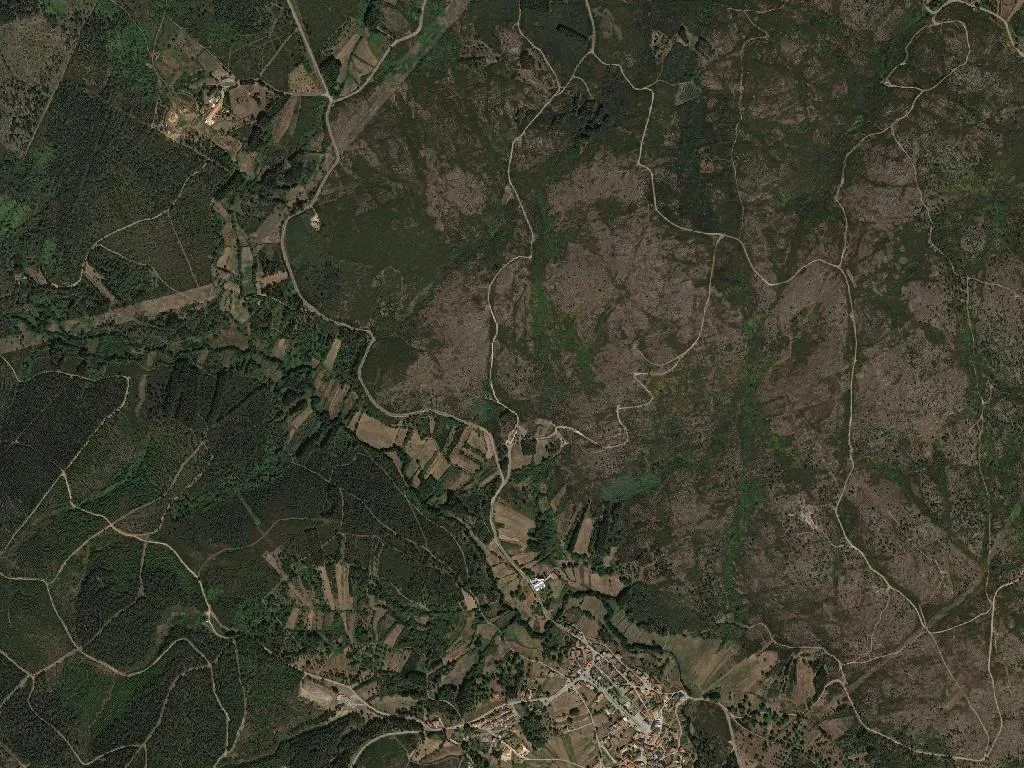
Mist rolls downhill like cold treacle, erasing the stone terraces that stitch themselves to the slope. At 897 m, Almofala inhales the thin air of the Serra da Gralheira; even in late spring the breeze carries teeth, and the only reply is the faint bleat of a goat somewhere inside the cloud. On the northern rim of Castro Daire, the village’s 222 permanent residents share acreage with wind and fog—neighbours more reliable than any human timetable.
Geometry against gravity
Nearly 1,860 ha are stapled to the mountain in granite ledges no wider than a dining table. Walls the colour of weathered pewter bind each platform, the stone prised out of the ground when the land was first claimed. Plot lines follow contour rather than compass: generations negotiated the incline with mattocks and winter patience, winning each square metre from heather and gorse. The same rock reappears in cottage eaves, village crosses, the milestones that steady hikers on the Torres variant of the Caminho Português.
Where the Way disappears
Pilgrims approaching Santiago via the high route drop into the parish after the lung-burning pull from Vila Maior. Between Almofala and the Paiva gorge the path narrows to a sheep track; yellow arrows blink through the granite like reluctant lighthouses. Locals call the stretch a ponte branca—the white bridge—because in saturated air you walk inside a lampshade, trusting paint instead of perspective. The experience is less postcard, more sensory deprivation tank: boots on schist, the smell of crushed pennyroyal, a church bell that might be fifty metres or half a valley away.
Fire and smoke at altitude
Kitchens here behave like alpine bothies. Wood-fired ovens deliver kid goat registered under the Cabrito da Gralheira IGP, the meat pre-seasoned by wild rosemary and rockrose the animals graze on. Veal from the Lafões denomination collapses into clay-pot stews dense enough to anchor a tarpaulin in a gale. In windowless fumeiros above the hearth, oak and chestnut smoke cure linguiça sausages for six months; the drier air at 900 m lets paprika and garlic linger in the muscle longer than in the coastal lowlands.
The arithmetic of absence
Census maths is brutal: 86 residents are over 65, only 12 under 14. Density is 11.9 souls per km²—lower than the Scottish Highlands. Empty dwellings outnumber occupied ones; bramble barricades swallow footpaths that once rang with clogs. Six granite cottages have been converted into self-catering units—an optimistic flutter that someone, anyone, will linger after the last chestnut falls. The smoke that still rises straight on windless afternoons signals firewood, stew, a chair pulled close to the hearth. How many winters the chimney keeps drawing, no one bets on out loud.