Full article about Cujó: where granite roofs graze the clouds above Viseu
At 854 m, Castro Daire’s tiny Cujó trades frost-cured rye, resinous kid and silence for crowds
Hide article Read full article
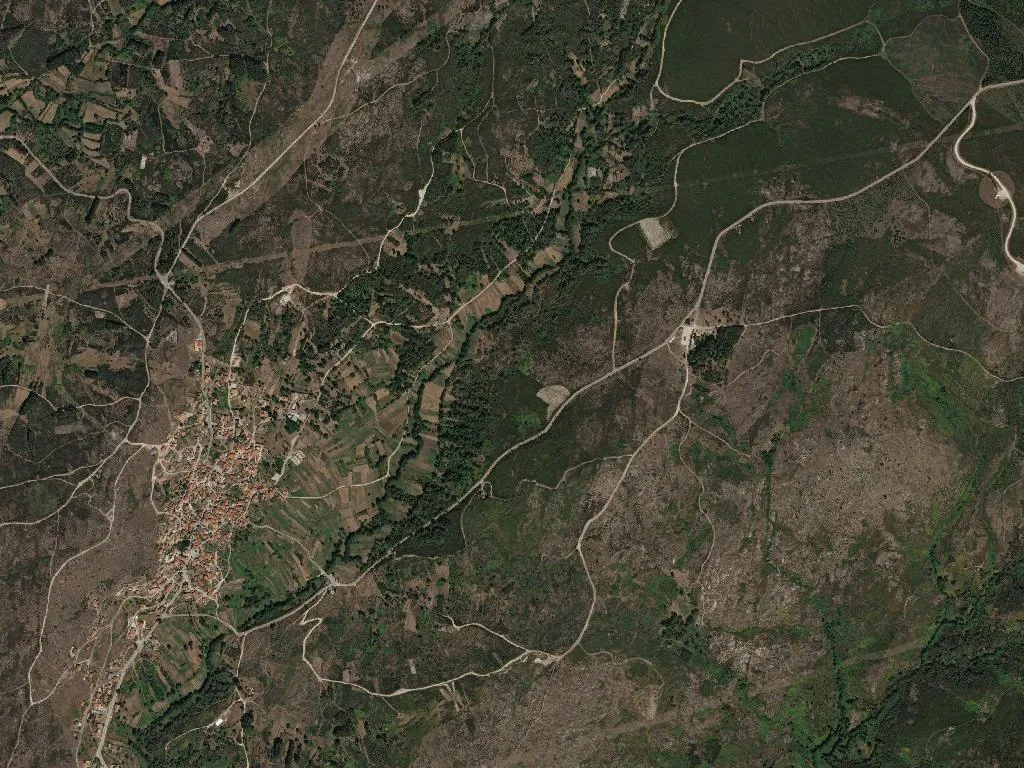
The tarmac coils upward until the speedometer trembles at 854 m and the wind begins to speak in full sentences. Suddenly the hillside peels open: Cujó, a scatter of granite and schist roofs pinned to the slope by gravity and habit. White smoke climbs from chimneys in a pencil-straight line, then unravels into the thin mountain air. Two hundred and forty-five souls share this aerie, spread across 850 hectares of heather and rye; silence is broken only by the church bell or the delayed echo of a sheepdog’s bark.
Altitude as daily labour
Living this high is a negotiation with frost. From October to May, dawn arrives as a milky fog that erases field boundaries; ice etches calligraphy on puddles well into April. Dry-stone walls parcel the incline into terraces still planted with rye and potatoes. The parish is ageing—102 residents over 65, just 15 under 15—yet every spring is known by heart: which spring runs first, which footpath cuts twenty minutes off the walk to the next hamlet.
Since 1502, when King Manuel I ratified the Portuguese stretch of the pilgrimage to Santiago, the Caminho de Torres has crossed these uplands. Modern walkers emerge from pine shadows to find a silence that cannot be bought, the only measure of progress the increasing thinness of the air and the widening view across the Vouga basin.
Meat that tastes of altitude
Food here is dictated by slope and pasture. Cabrito da Gralheira IGP, the kid that browses these inclines, feeds on rockrose, heather and wild marjoram; the meat carries the faint resinous note of the maquis. Vitela de Lafões IGP, the rose-veined veal from neighbouring communes, is slow-roasted with lard, garlic and bay until the kitchen windows steam. Both demand Dão reds—touriga-national and jaen—whose granite-edge acidity was born a valley away.
There are only three places to sleep: Casa do Lavrador, Casa da Eira and Casa da Quinta, stone houses restored without haste or theatrics. No concierge, no key codes, just wood-smoke, linen dried in mountain air and a night sky still audited by the International Dark-Sky Association.
The weight of granite
Evening light slants across the schist; walls glow like hot iron, then cool to gun-metal. Cujó offers no curated experiences, only the raw contract of altitude: the sting of wind, the scent of burning oak, the awareness that granite is heavier than flesh. Within an hour you will know whether you belong here—or whether the car engine turning downhill is already the sound of someone else’s memory.