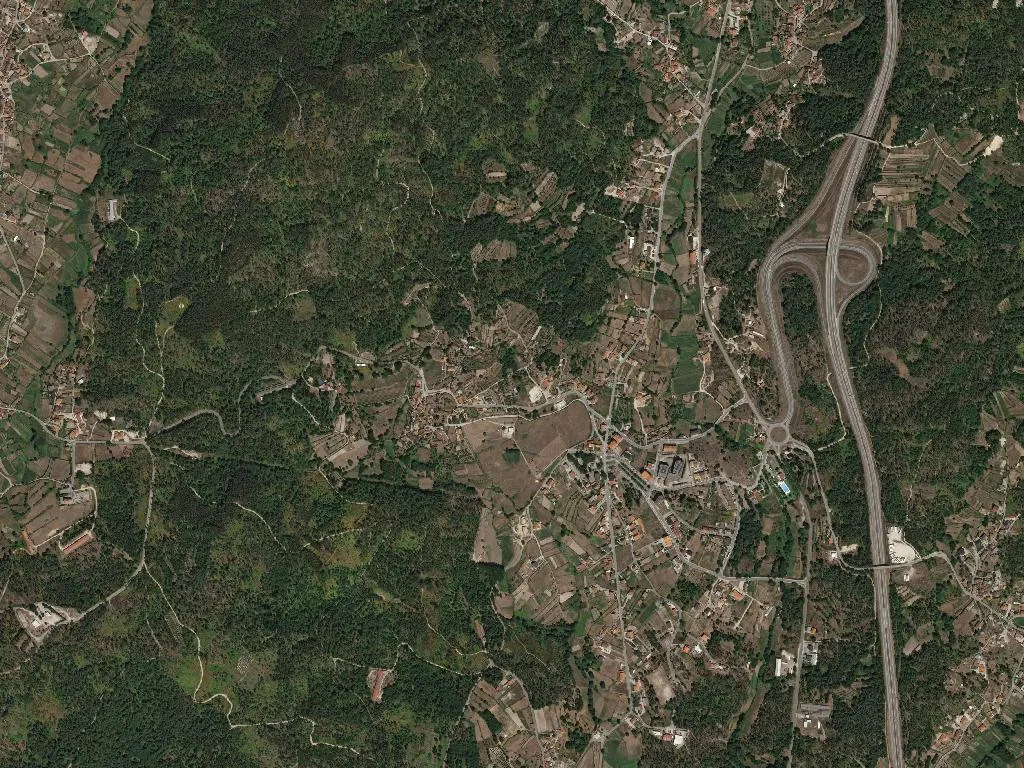
Full article about Sulphur Springs & Flax Fields of Mamouros-Alva-Ribolhos
Soak in 28 °C mineral water, then watch flax become lace in Castro Daire’s tri-parish watershed.
Hide article Read full article
Steam coils from the outdoor pool at Carvalhal like incense above a green nave of oaks. The water slips out of fractured granite at a steady 28 °C, sulphurous and bicarbonated, carrying the same metallic scent that Dr Sousa Martins praised in 1886 for “rheumatick complaints”. Behind the hiss of the inlet pipe the River Paiva mutters over rounded boulders, the only other sound an occasional clang from the 1892 ironwork that still carries the spring into the bath-house – a low, white building protected by law since 1977 and little altered since it opened.
Three names, one watershed
Mamouros, Alva and Ribolhos were stitched together administratively in 2013, yet they have always shared the same 529-metre contour line and the same dependence on water. Mamouros takes its name from the ten Bronze-Age burial mounds that rise through the heather like whale-backs; Alva refers either to the chalk-white soils or to the bright river that cuts through them; Ribolhos means “little eyes of water”, the springs that feed linen terraces and narrow vineyards. All three lay within the 12th-century Honour of Egas Moniz, schoolmaster to the boy-king Afonso Henriques, and all three were taxed in the royal inquest of 1220.
Dry-stone walls of grey granite still parcel the land into strips just wide enough for a scythe. In Alva’s water-meadows a dozen farmers continue to sow flax in April, the only parish in Castro Daire to do so. By late July the stems stand chest-high; they are pulled by hand, retted on communal threshing floors, then crushed in stone mills. On 15 August the “linen evening” brings out tablecloths embroidered with bleached thread and pullovers still woven on attic looms that creak like ships’ timbers.
Stone, carving and holy water
The parish church of Mamouros centres on a gilt carved altarpiece of 1750 whose acanthus leaves catch candle-light during the sung mass. Across the ridge in Alva, the baroque pediment of São Martinho frames a bell that tolls for All Souls through October fog. A simpler rectangle of granite and slate, the chapel of São Domingos in Ribolhos offers a stamp to walkers on the Torres variant of the Camino before they drop down to the Paiva gorge. Below the village the three-arched Ponte da Corredoura, dated 1789 on its central keystone, carries a mule track over the Mel stream whose bed it has polished for two centuries.
Kid, veal and Dão in a glass
Behind cottage doors, wood-fired ovens are lit at dawn. Gralheira IGP kid goat turns on the spit until the skin blisters and exhales rosemary; it arrives at table with rice flavoured by turnip tops and chestnuts roasted in the embers. Sunday means Lafões IGP veal casserole, the sauce darkened by smoked-wine chouriço and lifted by a Dão red poured from clay bowls in Carvalhal’s only tavern. The meal ends with two local larder notes: an aged sheep’s-cheese and a slice of requeijada, a set cheesecake scented with lemon peel, followed by mamouro biscuits – brittle rounds of cinnamon and nutmeg that taste of autumn fairs.
Water, rock and horizon
The PR1 “Paiva–Carvalhal” footpath runs eight kilometres between the river-beach at Covelinhas and the thermal spa, climbing through oak and sweet-chestnut forest whose floor crackles with last year’s leaves. At the Serrinha lookout, 580 m above sea-level, the valley peels away in layers of green and grey, the river a silver blade below. The trail lies within the Paiva sector of the Natura 2000 network; buzzards ride thermals above the riparian woodland while kingfishers skim the pools. In Ribolhos the waymarker is a granite cross where walkers kneel to tighten boots before the long descent west.
On September mornings, when mist fills the valley like water in a bowl, the bell of São Miguel in Mamouros strikes once, twice. The sound travels slowly across the flax stubble, rebounds off the opposite granite face and fades upstream, leaving only the echo of water on stone.