Full article about Pepim: where bread rises faster than the population
In Castro Daire’s granite parish, smoke-cured chouriço scents empty lanes
Hide article Read full article
Silence you can feel
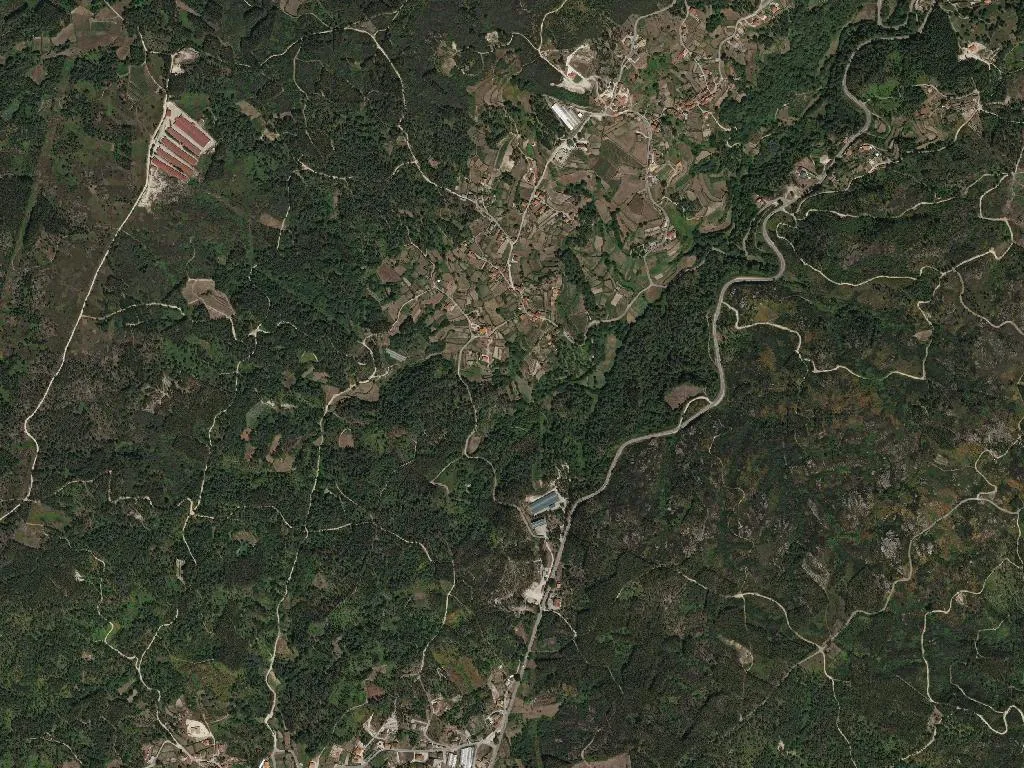
In Pepim the air arrives before the view. At 571 m it is thicker, tinged with wet slate and moss that furs every granite wall. Sound behaves differently here too: a single greeting in the church square takes two full seconds to fade down the valley, rolling across 1,193 hectares that are home to only 245 people. You do not escape noise; you acquire distance.
Those who stayed
There are nine children and eighty-eight pensioners. Walking sticks set the tempo, not bicycles. Yet the vegetable plots are forked to military straightness, the vines on their knuckles of schist pruned with surgical care. These smallholdings belong to the Dão wine region – even the steepest strip is planted, because good red refuses flat land. The demographic imbalance looks like decay; to the villagers it is simply the arithmetic of choice.
A pilgrim tide that never breaks
The Torres branch of the Camino de Santiago slips through the parish without signage. You recognise it by the worn cobbles, the roadside granite cross, the miniature chapels that punctuate the ridge like commas in a very long sentence. Hikers march north, eyes fixed on credentials to stamp; locals move sideways, hoeing a row or propping a wall. The two rhythms intersect but never merge.
Pass through at dawn and you will smell Dona Alda’s bread before you see it – yeast and dew combining into the illusion that time has reset itself overnight.
Smokehouse flavours
There are no restaurants. There are, however, fumeiros – smoke-filled outbuildings where chouriço blackens over oak, and kitchens where cast-iron pots slowly receive Cabrito da Gralheira IGP or Vitela de Lafões IGP. The seasoning is altitude, pasture and patience. By the time the meat reaches table it carries the scent of beam, rosemary and months of careful husbandry.
If you happen past Dona Odete’s during the winter matança, accept a square of warm morcela pressed into supermarket sliced bread. Refusal is classified as a diplomatic incident.
The luxury of no choice
Accommodation is limited to one registered dwelling; no boutique guesthouse, no yoga yurt. You sleep as someone’s guest, not as a paying customer, because there is simply nowhere else. That absence of options turns out to be the region’s rarest commodity: space without competition. At 20 inhabitants per km², the only queue is the slow drift of wood smoke.
Bring a jacket even in August. After dusk the wind slides out of the Pinhal forest and reminds you that you are half a mile above sea level. The evening breeze scatters dry leaves along the tarmac, then the six-o’clock bell tolls. There is nothing to do but listen as the note widens over the valley, thins, and dissolves, returning the valley to its natural currency – silence you can almost weigh in your hand.