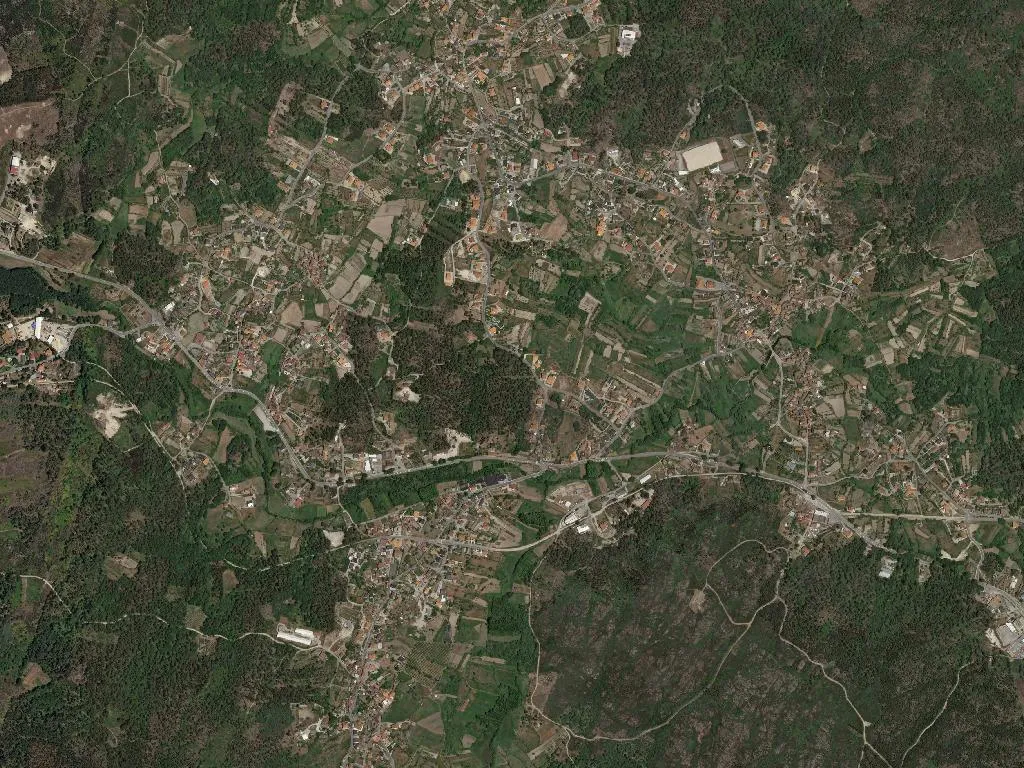
Full article about Bodiosa: Where Chouriço Smoke Writes the Village Map
Serra do Dão hamlets, granite terraces and oak-cured hams flavour every lane of this Viseu parish.
Hide article Read full article
The smoke from the curing shack drifts lazily between the dark ceiling beams, carrying the scent of chouriço and decades of smouldering oak. In Bodiosa, 470 m up on the Dão’s sunlit slopes, food is not folklore—it is the village’s daily pulse. Among 2,840 neighbours spread across barely 25 km², black-ribbed hams still swing over smouldering vines, milk still clots in pinewood moulds, and lambs graze the boulder-strewn inclines that drop towards the river.
Geography you can taste
Picture the scene in a provincial café: one table holds four farmers talking across one another, their voices loud but never wasted. Bodiosa is arranged the same way—hamlets clustered within earshot, separated only by rows of red-skinned vines and water-meadows where herons pace. Granite outcrops push through the topsoil like eavesdroppers. Dão terraces, stitched together with dry-stone walls, are planted with a grape that shrugs off Atlantic storms. But the real map is edible: Serra da Estrela lamb, Gralheira kid, Arouquesa beef, Terrincho and Serra da Estrela cheeses, requeijão curd, Lafões veal. These are not menu adjectives; they are animals you will meet in the next field, milk that leaves the pail still warm, cheeses that cure in the same loft where grandfather once hung his scythe.
Two plaques, one collective memory
Only two buildings in the parish wear the little blue republican plaque—scant official heritage, yet enough if you know where to look. The granite is identical to the stone that chips your hoe when you cut drainage ditches: unapologetically hard. Doorsteps are dished by generations of clogs; ask 84-year-old Sr António and he can still reckon the number of grape baskets that have crossed them. There are 832 residents over sixty-five and only 311 children under fourteen—demographics that leave hollow houses but no vacuum of memory. Ask who built the chapel, where the water-mill turned, how many harvests filled the granary and the answer comes faster than Google.
The Torres way, walked by the few
The Caminho de Santiago’s lesser-known Torres route clatters through the village on a tractor-rutted lane. Forget scallop-shell way-marking and detox retreats; here the pilgrim climbs a calf-burning incline, tastes road dust and thanks heaven for the next stone spout. Few pass, but those who do linger: they fill bottles at the spring, buy crusty broa from D. Amélia’s bakery, ask how far to the next hamlet. The reply—"depends on your legs"—is mathematically precise. No queue for selfies, just a view straight down the Dão gorge and quadriceps that will remember the place tomorrow morning.
Somewhere to sleep: one house, no concept
There is a single registered guest-house. It offers no rooftop bar, no lifestyle shop, only line-dried sheets that smell of olive-oil soap and a proprietress who will bring coffee at eight if you ask. Guests come to eat Terrincho cheese with unlabelled tinto in a thick glass bowl, to hear curd squeak between teeth, to wake to the neighbour’s cockerel and wander off-schedule. The family who run it know which footpath leads to the shepherd who still uses cardoon thistle for rennet, which cellar pours backyard Dão into heavy tumblers and refuses to sell a drop beyond the parish boundary.
The church bell strikes six. Its note ricochets off the granite, hovers like a swallow, then settles. No one remarks on the hour; smoke keeps rising, woodsmoke merges with dusk, and life continues without asking permission.