Full article about Santa Eufémia & Boa Vista: Pig Smoke Meets Prehistory
Leitão crackles above a 24,900-year-old child in Leiria’s overlooked double parish
Hide article Read full article
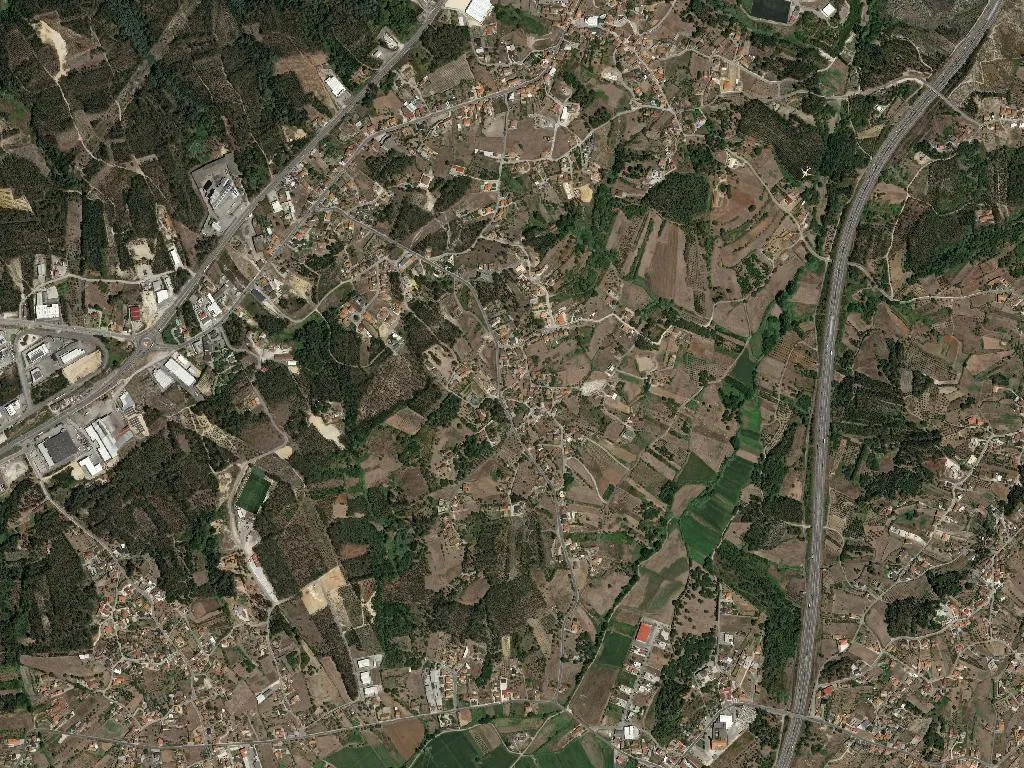
The scent of crackling suckling pig drifts from Rui’s wood oven on Rua dos Combatentes, braiding with the sharper tang of orange-tree prunings smouldering in back gardens. At 132 m above sea-level the parish unrolls like a late-summer quilt: red-tiled Nineties houses, abandoned pear orchards and regimented eucalyptus that scale the ravine walls. Rural and suburban share the same breath here, paid for by unemployment benefit and the two minimum-wage salaries earned on the daily commute into Leiria.
Two hamlets, one recent story
Administrative reform in 2013 stitched Santa Eufémia—its gravitational centre an eighteenth-century church and Zé Manel’s café—onto Boa Vista, a strip that ballooned along the EN-109 after the CIMPOR cement plant arrived and roadside rotisseries opened in the Eighties. Santa Eufémia still has farmers who tend plots in the Veiga and Charneca valleys; Boa Vista measures time by the rumble of lorries bound for Intermarché and the white-noise whoosh of the A8. Walk the two kilometres between them and you watch history retrofit itself: fig trees and loquats survive in walled gardens, but fresh concrete frames climb the hills and the 206 inhabitants-per-km² owe more to housing estates than to babies.
Lapedo Valley and the soil’s secrets
Three kilometres west, the Lapedo cut slices through shale to reveal the Abrigo do Lagar Velho, where archaeologists unearthed the 24,900-year-old skeleton of a Cro-Magnon child. Since 2017 the €1.2 million EcoPLis project has occupied the former primary school at Apariços; each summer Ana Cristina Araújo’s team from Lisbon’s UNIARQ returns to peel back millennia. Volunteers pay €300 for a fortnight’s trowel work and bunk down in the sports hall. Ask Ti Joaquim, who grazes his goats on the slope, and he’ll remember finding “one of those big teeth” here in the Seventies, pocketing it without realising he was cradling prehistory.
Piglet, honey and fruit with paperwork
Leitão da Boa Vista is served at O Afonso exactly as it has been since 1983: €14 a plate, €28 for half a pig, €55 for the whole beast. The skin blisters because the carcass enters the wood oven at 4 a.m. and emerges at 11 after three hours at 250 °C. Behind the GNR police post Celestino keeps a dozen hives on the lower slopes of the Serra da Lousã and sells raw honey for €6 a kilo—no PDO stamp, “but who needs a label? It’s the same honey my father made.” Alcobaça apples and Pêra Rocha do Oeste pears no longer ripen here; the orchards were grubbed up long ago. Instead Sandra at the roundabout fruit shop trucks them in from the west three times a week.
Between daily life and the pilgrim road
The coastal variant of the Camino de Santiago passes the Igreja da Boa Vista, but walkers are scarce—perhaps two a week in high season. Far more regular are the AVIC company buses that haul workers to Leiria’s industrial estates at 7:15 a.m. and drop them back at 6:30 p.m. The 2021 census counted 1,145 residents over 65 and only 472 children under 14. Young families still buy €120,000 semi-detached houses on the Picheleira estate, yet Santa Eufémia’s primary school closed in 2019; 42 pupils now share six year-groups at Boa Vista’s EB 2,3.
Dusk settles slowly over Boa Vista’s rooftops. In the Apariços lab Ana Cristina bags soil samples marked “US 12, layer 4”. Adelino’s unpruned pear trees seethe with fruit-fly. And inside O Afonso the ovens are firing again—tomorrow a Spanish coach party has pre-ordered twelve piglets.